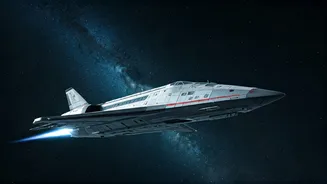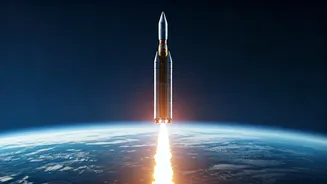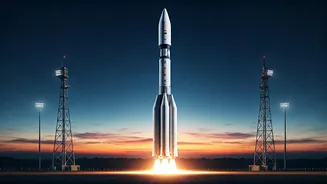





The Final Frontier: India's Ambition
The Gaganyaan programme, led by the Indian Space Research Organisation (ISRO), is the nation's ambitious endeavour to demonstrate human spaceflight capability. The primary objective is to launch a crew of three into a 400-kilometre orbit for a three-day
mission and bring them back safely to Earth, landing in Indian sea waters. [21] Achieving this would make India the fourth nation in the world, after Russia, the United States, and China, to possess independent human spaceflight capability. [5, 13] This isn't just a symbolic quest; it represents a major leap in India's technological prowess and its ambition to become a key player in the global space economy, which is projected to grow significantly. [6] Recent statements by Prime Minister Narendra Modi have underscored this, linking Gaganyaan to the future establishment of a 'Bharatiya Antariksh Station' (Indian Space Station) by 2035. [10, 21]
Meet the Vyomanauts
The nation was introduced to the four astronaut-designates in February 2024: Group Captains Prashanth Nair, Ajit Krishnan, Angad Pratap, and Shubhanshu Shukla. [3] These decorated Indian Air Force test pilots have been undergoing extensive training, both in Russia and at India's dedicated Astronaut Training Centre in Bengaluru. [3] The training covers a vast range of skills, from mission simulations and survival techniques to the psychological and physical rigours of spaceflight. [3] In a significant precursor to Gaganyaan, Group Captain Shubhanshu Shukla participated in a NASA-ISRO joint mission to the International Space Station (ISS) in mid-2025, gaining invaluable real-world experience. [3, 19] The term 'Vyomanaut', derived from the Sanskrit word 'Vyoma' for space, has been chosen to designate these Indian space travellers, distinguishing them from their American astronaut and Russian cosmonaut counterparts. [14, 18]
Crucial Tests on the Horizon
Before astronauts can fly, the technology must be proven flawless. The year 2026 is pivotal for Gaganyaan, with a series of uncrewed test flights scheduled. The first key uncrewed flight, known as Gaganyaan-1 (G1), is slated for the second half of 2026. [2, 9] This mission will be launched using the human-rated LVM3 rocket (HLVM3) and will carry 'Vyommitra', a sophisticated humanoid robot developed by ISRO. [4, 5] Vyommitra will simulate astronaut functions, monitoring the crew module's environment and life-support systems, providing crucial data on how a human would fare. [5, 9] This flight is designed to validate the entire mission sequence, from launch and orbital manoeuvres to re-entry and recovery. [4, 7] ISRO has planned for at least one more uncrewed mission after G1 to ensure the highest levels of safety and reliability before the first crewed flight, which is now targeted for 2027. [4, 7]
Why Gaganyaan Matters
The Gaganyaan mission is more than a technological showcase; it's a catalyst for national development. The programme is expected to inspire a new generation to pursue careers in science and technology and has already fostered a burgeoning domestic space industry. [2, 21] As of early 2026, the number of space startups in India has grown to over 400, a massive jump from just one in 2014. [2, 19] Developing critical technologies for human spaceflight, such as advanced life-support systems and reliable crew escape mechanisms, has spin-off applications in other sectors. [15] Furthermore, the mission strengthens India's strategic autonomy and its standing in international collaborations, opening doors for joint missions and scientific research on a global scale. [2, 19] Looking beyond the initial flights, ISRO is already planning to include civilians—such as scientists and doctors—in future missions to expand the scope of in-orbit research. [17]