





The Recline and Shell Seat Trap
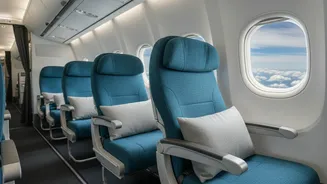
The biggest promise of Premium Economy is more space, and a key part of that is recline. A few extra inches of tilt can make a world of difference on a long-haul flight. However, airlines are increasingly using “fixed-shell” or “hard-shell” seats. In
these designs, the back of your seat doesn’t actually tilt backwards. Instead, the seat cushion slides forward and down to create a reclining position. The major advantage is that you don't encroach on the space of the person behind you. The downside? Many passengers find this sliding motion unnatural and less comfortable than a traditional recline. It can also create a feeling of being pushed down and forward. If deep, traditional recline is important for your comfort, especially for sleeping, a fixed-shell seat might be a dealbreaker. Always check reviews of the specific airline and aircraft seat you're considering.
Not All Footrests Are Created Equal
This is one of the most inconsistent features in Premium Economy. The best-case scenario is a cushioned, adjustable leg rest that extends from your seat, supporting your entire lower leg. This is a significant upgrade that helps you elevate your feet and sleep more comfortably. More common, however, is a simple, metal foot bar that folds down from the seat in front of you. While better than nothing, this bar provides limited support and can be awkward for taller or shorter passengers. Some airlines offer a hybrid: a small, padded footrest that folds out. Critically, bulkhead seats (the first row of the cabin) often have a different setup entirely, sometimes with a leg rest that folds out from the seat itself, as there's no seat in front to attach a bar to. Don’t just see “footrest” on a feature list and assume the best; try to find photos or specific descriptions.
The Bulkhead Row Dilemma
The bulkhead is the wall that separates cabins. Selecting the first row of Premium Economy, right behind this wall, comes with distinct pros and cons. The biggest pro is that no one can recline into your space, and you often have more open space in front of your knees. However, there are significant drawbacks. Bulkhead seats can sometimes have less overall legroom because you can't slide your feet under the seat in front of you. Your feet will hit the wall. The armrests are almost always fixed and immovable because they contain the tray table and entertainment screen, which can make the seat feel narrower. Furthermore, all your personal belongings must be stored in the overhead bin for takeoff and landing, which can be inconvenient. For some, the guaranteed personal space is worth it; for others, the restrictions are a major annoyance.
How to Decode the Seat Map
Before you book, become a detective. Your first stop should be the airline's website during the booking process to view the seat map. This shows you the cabin layout, like a 2-4-2 or 2-3-2 configuration. For a more detailed, independent view, use specialist websites. While SeatGuru was once the standard, many frequent flyers now find sites like AeroLOPA provide more accurate and up-to-date diagrams of aircraft interiors. These sites can help you identify the exact version of the aircraft you'll be on and see precise seat details. Look for seats marked with caution—they may be close to high-traffic galleys or lavatories, or have limited recline. Cross-referencing the airline map with an independent site gives you the most complete picture of what you're actually paying for.
Beyond the Big Three: Other Factors
While recline, footrests, and row position are critical, other details complete the picture. Seat pitch—the distance from one point on a seat to the same point on the seat in front—is the industry measure for legroom. Premium Economy typically offers a pitch of 36 to 38 inches, compared to 30 to 33 inches in Economy. Seat width is just as important; an extra inch or two can make a surprising difference in comfort. Also, remember that the experience can vary dramatically even within the same airline. A flight on a new Boeing 787 might have a fantastic, modern Premium Economy product, while an older aircraft on a different route might have a tired, outdated version. The aircraft type, which you can usually find during the booking process, is often the single biggest clue to the quality of the seat you will get.