
An Icon of the Solar System
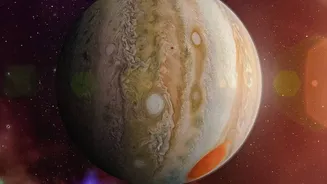
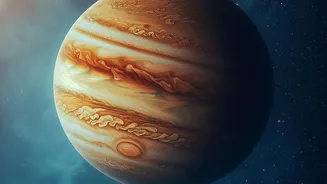
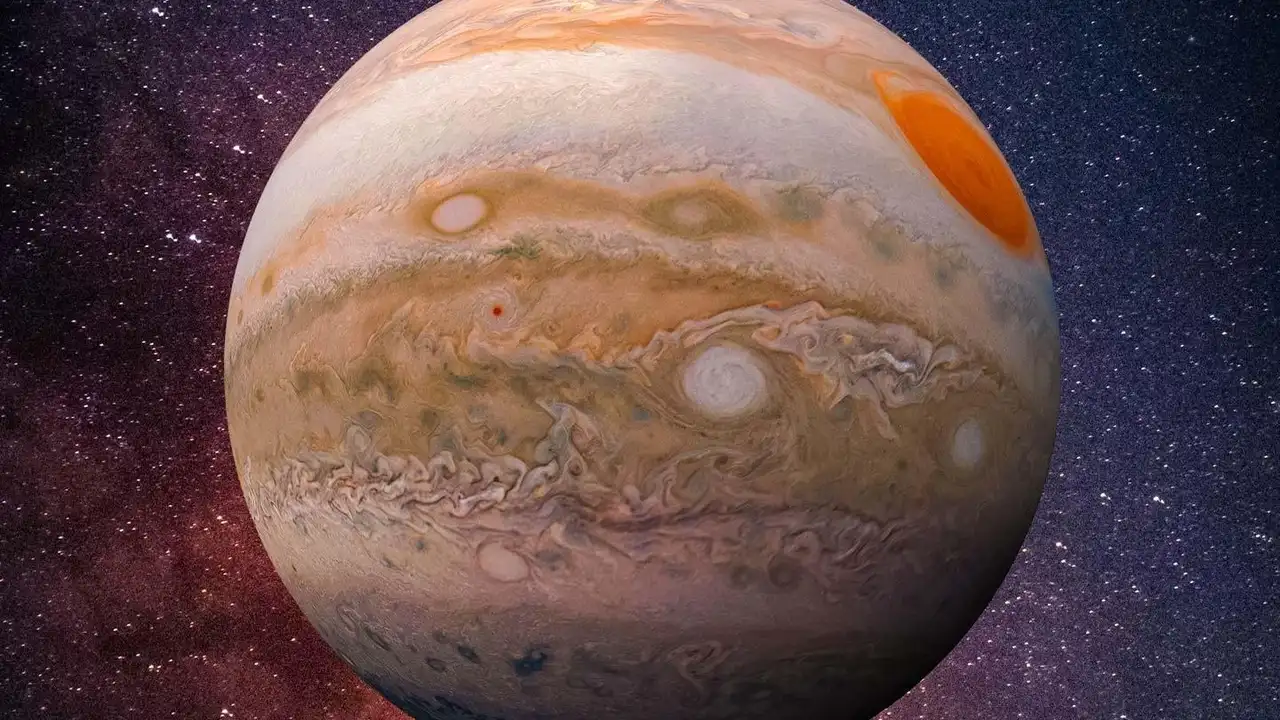
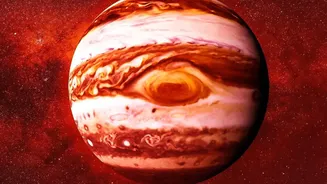
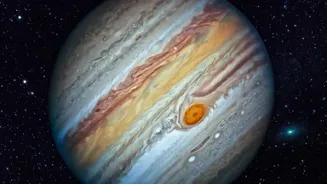
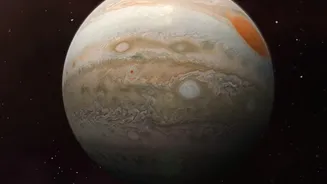
The Great Red Spot is the most famous storm in the solar system. It’s a gigantic anticyclone—a high-pressure system that rotates counter-clockwise in Jupiter’s southern hemisphere, with winds far exceeding the most powerful hurricanes on Earth. For as
long as we have had telescopes capable of observing it in detail, this storm has been a subject of fascination. First continuously observed in the 1830s, it was once vast enough to swallow three Earths side-by-side. Its striking red-orange colour, the exact chemical cause of which is still a mystery, makes it Jupiter's most recognisable feature. Scientists believe the colour may come from compounds in the upper atmosphere getting a 'sunburn' from solar radiation, but no one is certain.
The Shrinking Giant
The most dramatic change scientists have tracked over the last century is the storm's incredible shrinking act. Since the late 1800s, the Great Red Spot has contracted significantly. What was once a large oval is now much smaller and more circular. By the time NASA's Voyager probes flew past in 1979, it was down to about 14,500 miles across; today, high-resolution images show it is now barely wider than our own planet. This shrinkage has accelerated in recent years, losing hundreds of miles of its width annually. This has led some astronomers to speculate whether we might be the last generation to witness this iconic storm. Projections suggest that if the current rate continues, the spot could become perfectly circular by 2040, a major shift for the long-lived storm.
A View from the Cosmic Detectives
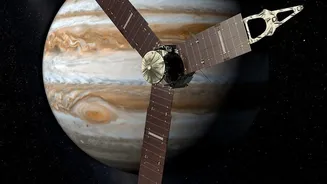
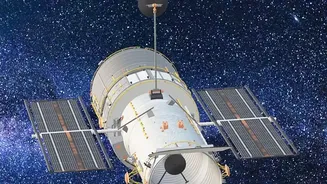
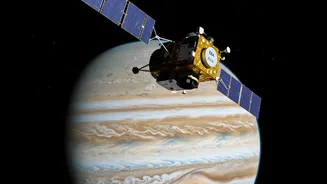
To understand these changes, scientists are relying on incredibly detailed, high-resolution images from instruments like the Hubble Space Telescope and NASA's Juno spacecraft, which is currently orbiting Jupiter. The Outer Planet Atmospheres Legacy (OPAL) program uses Hubble to take yearly snapshots of the outer planets, creating a long-term weather report for worlds like Jupiter. These consistent observations allow scientists to track not just the shrinking, but also other strange behaviours. Recent Hubble data from late 2023 and early 2024 revealed the storm is jiggling and oscillating in size over a 90-day cycle, something never clearly identified before. Meanwhile, the Juno probe has been able to measure the storm's depth, finding that the vortex extends over 350 kilometres down into the planet's atmosphere.
What's Driving the Changes?
So, what's causing the solar system's greatest storm to lose its punch? The truth is, nobody knows for sure, but there are several leading theories. One idea is that the changes are linked to the storm's diet. The Great Red Spot is wedged between two powerful jet streams that help keep it stable, and it also feeds on smaller, passing storms to sustain its energy. Recent modelling suggests that a decline in the number of these smaller storms being 'eaten' by the larger vortex could be causing it to shrink. Another possibility is that the storm is simply losing energy and its own internal dynamics are causing it to become rounder and smaller over time. The recent discovery of its 'wobble' adds a new layer of complexity, and scientists currently lack a clear hydrodynamic explanation for it.