



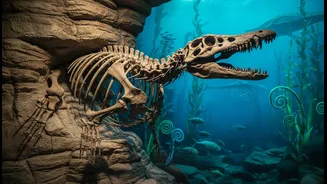


From Stone to Skeleton
The journey from a fossil discovery to a museum display is a masterclass in detective work. It begins not with a complete skeleton, but often with fragments of bone, teeth, or shells. Paleontologists first have to carefully excavate these pieces from the surrounding
rock, a delicate process that can take years. Once in the lab, these fragments are cleaned and stabilised. The first big task is identification: is it bone or rock? Fossilised bone often retains a spongy, honeycomb-like internal structure, distinguishing it from ordinary stone. The next step is to figure out what kind of animal it belonged to by comparing it with the bones of known species, both living and extinct. This process, called comparative anatomy, is the foundation of all reconstruction. By studying the anatomy of modern animals, scientists can make educated guesses about the structure of their ancient relatives.
A 450-Million-Year-Old Puzzle
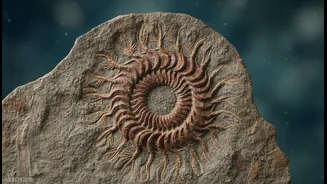
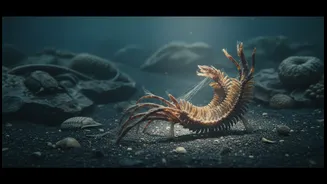
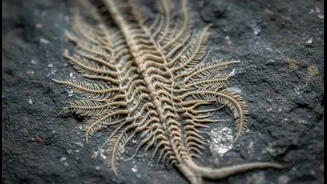
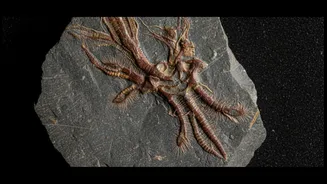
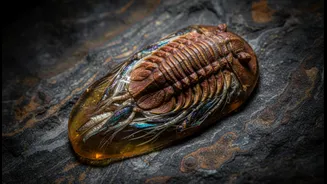
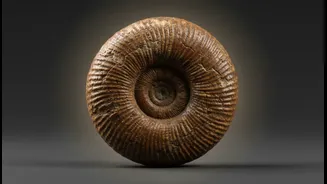
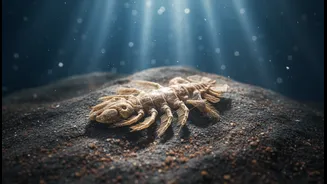
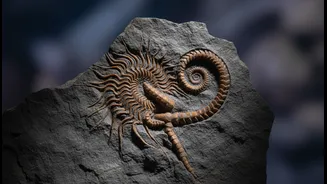
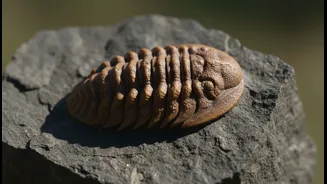
Let's travel back 450 million years to the Ordovician period. At this time, life was almost entirely confined to the oceans, which teemed with diversity. This era saw a massive expansion of life, with the evolution of early fish, corals, and countless invertebrates like trilobites and crinoids. Reconstructing an animal from this deep past is uniquely challenging because the vast majority of fossils are of hard parts like shells and bones. Soft tissues—skin, organs, and muscles—rarely survive. That’s why a recent discovery of a 450-million-year-old crinoid (a relative of starfish) with preserved soft tissue was hailed as a 'one in a million' find. It provides an incredibly rare, direct window into the biology of an ancient creature, allowing scientists to understand its feeding strategy and anatomy with a clarity that is usually impossible. But for the most part, scientists work with incomplete information, piecing together a puzzle with most of the pieces missing.
The Art of Scientific Inference
How do you reconstruct an animal's behaviour or appearance from just its bones? Scientists look for clues. Muscle scars on bones can indicate the size and placement of muscles. The shape of teeth tells a story about diet—sharp, pointed teeth suggest a carnivore, while flat, grinding teeth point to an herbivore. The structure of limbs and joints can reveal how an animal moved. Advanced techniques, like biomechanical modeling and 3D scanning, allow researchers to test hypotheses about locomotion and function digitally. But this is where the risk of overstatement becomes greatest. Inferring behaviour is much more speculative than reconstructing a skeleton. While footprints can tell us how an animal walked, and stomach contents can confirm its last meal, broader conclusions about social structures or hunting patterns are hypotheses built on layers of inference.
The Danger of a Good Story
Science is a self-correcting process, and paleontology is filled with famous examples of getting it wrong before getting it right. One of the most iconic is the Iguanodon. When first discovered in the 1820s, its thumb spike was mistakenly placed on its nose as a horn, because that's what seemed logical based on modern reptiles like iguanas. It wasn't until more complete skeletons were found decades later that the spike was correctly identified as being on its hand. Similarly, early reconstructions showed dinosaurs dragging their tails, a posture later corrected by a better understanding of their spine and musculature. These 'mistakes' aren't failures; they are a vital part of the scientific method. Initial hypotheses are tested with new evidence, and our understanding evolves. The danger lies in presenting a speculative reconstruction as confirmed fact.
Beyond the Bones
What about colour, skin texture, and sound? These are the frontiers of paleontological reconstruction, and the areas where scientists must be most cautious. For a long time, the colour of dinosaurs was pure guesswork, often based on the patterns of modern reptiles. However, the discovery of preserved melanosomes (pigment cells) in some feathered dinosaur fossils has allowed scientists to reconstruct their original colours with some confidence. But these finds are exceptionally rare. For most species, any depiction of colour is artistic license, an educated guess based on the likely environment and behaviour of the animal. Reconstructing an ancient world requires not just scientific rigour but also intellectual humility—an acknowledgment of what we know, what we can reasonably infer, and what remains a tantalising mystery.