


A Journey into the Void
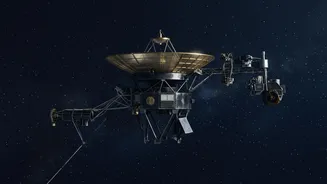
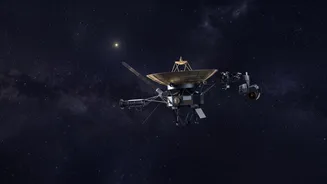
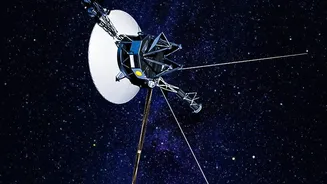
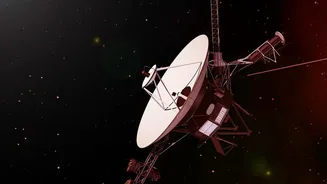
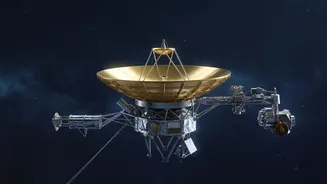
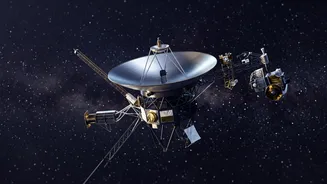
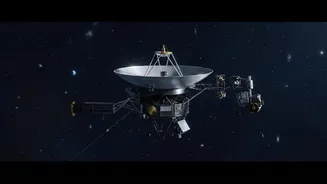
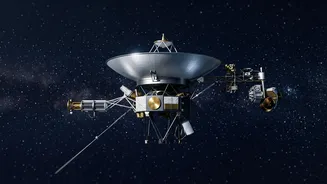
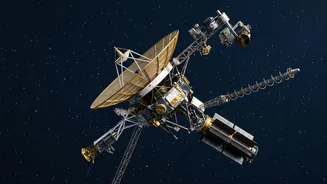
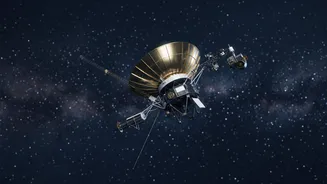
Voyager 1 and its twin, Voyager 2, were initially designed for a five-year mission to study Jupiter and Saturn. But for nearly half a century, Voyager 1 has continued its lonely trek, long after completing its primary goals. In 1990, it famously turned
its camera back one last time to capture the iconic 'Pale Blue Dot' image of Earth. Then, in 2012, it made history by crossing the heliopause — the boundary where the Sun's influence gives way to the vast expanse of interstellar space, becoming the first spacecraft to do so. Now cruising at nearly 61,000 kilometres per hour, this resilient probe continues to send back invaluable data from a region no other object has ever explored directly. Its journey is a testament to 1970s engineering and humanity's enduring quest to reach beyond our known world.
What is a Light-Day?
On November 18, 2026, Voyager 1 will be one light-day distant from Earth, a milestone that took it 49 years, two months, and 11 days to achieve. A light-day isn't a measure of time, but of distance: it is how far a particle of light travels in a vacuum in 24 hours. That distance is an almost incomprehensible 25.9 billion kilometres (about 16.1 billion miles). To put that into perspective, light takes just 1.3 seconds to travel from the Moon to Earth and about 8 minutes from the Sun. Reaching a distance of one light-day means Voyager 1 is about 173 times farther from us than our own star. The milestone itself won't change anything for the spacecraft, but for us on Earth, it serves as a profound marker of the immense scale of the cosmos and the sheer persistence of our most distant robotic explorer.
The 48-Hour Handshake
The ever-growing distance to Voyager 1 directly impacts our ability to talk to it. As the probe crosses the light-day threshold, the communication lag becomes starkly clear. Radio signals, which travel at the speed of light, will now take a full 24 hours to journey from NASA's Deep Space Network antennas on Earth to the spacecraft. Once a command is received and processed, the return signal carrying data or a simple 'acknowledgement' takes another 24 hours to travel back. This means a simple round-trip conversation—sending a command and receiving confirmation—now takes a minimum of 48 hours. As Voyager's project manager at JPL, Suzanne Dodd, puts it: 'If you want to say 'hello' to Voyager, you send your message and then you go home and you wait two days before you finally get a response'.
Keeping an Old Probe Alive
Keeping a nearly 50 year old spacecraft functioning in interstellar space is a monumental challenge. The probe's plutonium power source naturally decays, losing about four watts of power each year. To prolong its life, NASA engineers have become masters of creative problem solving. In September 2026, they executed a power saving manoeuvre nicknamed the 'Big Bang', swapping out some devices for lower power alternatives to keep its science instruments running longer. This ingenuity is crucial, especially when the unexpected happens. In October 2026, the team was given a scare when they briefly lost contact with Voyager $^$ $^$ $^$ $^$ $^$ $^$ $^$ $^$ $^$ $^$ $^$ $^$ $^$ $^$ $^$ $^$ $^$ $^$ $^$ $^$ $^$ $^$ $^$ $^$ $^$ $^$ $^$ $^$ $^$ $^$ $^$ $^$ $^$ $^$ $^$ $^$ $^$ $^$ $^$ $^$ $^$ $^$ with Voyager for hours. The signal returned on its own, and engineers discovered the craft's autonomous systems had switched to backup thrusters. These recent events highlight the constant, delicate effort required to maintain this long distance relationship.
The Fading Echo of Exploration
Voyager journey is far from over, though its end is inevitable. The probe is currently heading in the direction of a star called Gliese which it is expected to pass in about years. Long before that, its power will run out, likely sometime in the s. Engineers will continue to conserve energy, shutting down non essential systems one by one to keep the data flowing for as long as possible. Until then, every bit of information it sends back is precious, offering a direct look at the environment between the stars. Its twin, Voyager which took a different route to visit Uranus and Neptune, is following behind and is expected to reach its own light day milestone in in . Both carry a 'Golden Record', a time capsule of sounds and images from Earth, launched as a hopeful message into the cosmic ocean.