



Your Hands Are the First Toolkit
One of the most reliable and readily available measuring tools you own is your hand. It’s a convenient guide that chefs and nutritionists use to estimate portions quickly. For smaller measurements, think of your thumb. The tip of your thumb, from the top
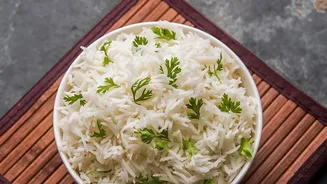
knuckle to the tip, is roughly equivalent to one teaspoon, perfect for things like butter or oil. The entire thumb, from its base to the tip, is about the size of a tablespoon. This is a great reference for salad dressings or peanut butter. For larger quantities, your palm can represent about a three-ounce serving of protein like chicken or fish. A cupped hand can hold about half a cup of ingredients like nuts or pasta, while a closed fist is a good approximation for a full cup of things like rice or chopped vegetables.
Everyday Objects as Measurement Guides
Beyond your hands, your kitchen is already full of objects that can stand in for formal measuring tools. Many experienced cooks develop a personal vocabulary of visual cues over time. For example, a standard deck of playing cards is about the same size as a three-ounce portion of meat, which can be a helpful visual check against the palm of your hand method. A tennis ball is a good stand-in for a half-cup, while a baseball is closer to a full cup. Even the cap from a bottle of olive oil can be a useful proxy; many are roughly equivalent to a teaspoon. The key is to find reliable objects in your own environment. A standard coffee mug usually holds about one to one-and-a-half cups, and a shot glass typically holds one ounce, which is equal to two tablespoons.
Visualizing Dry vs. Liquid Ingredients
Measuring dry and liquid ingredients presents different challenges. With liquids, the main goal is to get to eye level with your container to see the volume accurately. For dry goods, the density can change how much fits into a space. For example, one cup of packed brown sugar is very different from one cup of sifted flour. While eyeballing is useful, it’s important to understand how recipes treat these ingredients. If a recipe calls for “one cup of sifted flour,” it means you should sift the flour first and then measure it. If it says “one cup of flour, sifted,” you measure first, then sift. For visual estimation, remember that a stick of butter is almost universally equivalent to half a cup. This can be a useful anchor when judging other solid fats or ingredients.
Calibrate Your Eye with Practice
Becoming comfortable with eyeballing measurements is a skill that improves with practice. The best way to train your eye is to test yourself. The next time you are cooking, try to estimate a quantity first—a tablespoon of olive oil, a cup of rice, a teaspoon of salt. Then, use an actual measuring spoon or cup to see how close you were. This act of guessing and then verifying creates a strong mental link between the abstract measurement and the physical quantity. Over time, you will need to rely on the measuring tools less and less. This doesn't mean you should throw your measuring cups away; precision is still crucial, especially in baking where the science of ratios is unforgiving. However, for most everyday cooking, developing this intuitive sense of measurement will make you a faster, more confident, and more creative cook.