
Seeing the Unseen with Infrared
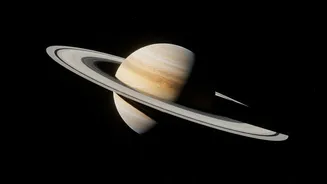
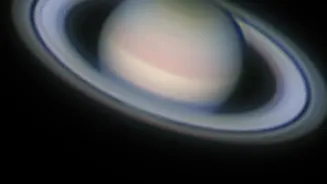
While Saturn may look like a serene, butterscotch-coloured orb in visible light, this view hides a chaotic world of high-speed winds and colossal storms. This is where the Hubble Space Telescope's infrared capabilities become essential. Infrared light can
penetrate the hazy upper atmosphere, which is composed mostly of hydrogen and helium with traces of ammonia and methane, allowing scientists to see deeper into the cloud decks. By capturing images in different infrared wavelengths, researchers can effectively slice through Saturn's atmosphere at various altitudes, almost like peeling the layers of an onion. This provides a three-dimensional understanding of how storms form, how heat is distributed, and how the planet's weather systems evolve over time.
Tracking a Planet Through Its Seasons
One of Hubble's most significant contributions is its long-term monitoring of Saturn. Since a year on Saturn lasts for about 29 Earth years, its seasons are each more than seven years long. Programs like the Outer Planets Atmospheres Legacy (OPAL) use Hubble to take yearly snapshots, creating an invaluable record of seasonal changes. Observations have captured the transition from the northern hemisphere's summer into autumn. During its summer, increased sunlight can cause a reddish haze to form over the northern hemisphere. As the seasons shift, so do the colours and brightness of Saturn's characteristic bands, with the equator brightening by 5 to 10 percent between 2018 and 2020. The southern pole, emerging from winter, has been observed to have a distinct blue hue, possibly because the lack of direct sun reduces haze formation.
A World of Turbulent Storms
Hubble's infrared eyes have revealed that Saturn's atmosphere is far from calm. The planet is one of the windiest places in the Solar System, with equatorial wind speeds clocked at up to 1,600 kilometres per hour. These powerful winds shape massive storms, some of which are as large as Earth. While some of these storms are transient features that appear and disappear between yearly observations, others leave a lasting impact. For example, even years after the “Great Springtime Storm” of 2011-2012, its lingering remnants are still visible in recent observations. The combination of Hubble's long-term visible light monitoring and the deeper infrared views from telescopes like the James Webb Space Telescope allows scientists to study not just the tops of these storms, but also the underlying atmospheric waves that shape them.
The Enduring Mystery of the Hexagon
One of Saturn's most famous and bizarre weather features is the massive, six-sided jet stream at its north pole, known simply as 'the hexagon'. Each side of this incredible structure is longer than the diameter of Earth. First spotted by the Voyager spacecraft in the 1980s, its persistence for decades highlights the remarkable stability of some large-scale atmospheric phenomena. Recent observations from Hubble and Webb have provided some of the most comprehensive views of this feature to date. However, these may be the last high-resolution looks scientists get for a while. As Saturn's northern pole tipped toward its long winter in 2025, the hexagon is now entering 15 years of darkness, making it impossible to see until the 2040s.