


The Telltale Signs of a Violent Past
Planetary systems are not born in perfect order. Their early lives are often chaotic, marked by titanic collisions between infant planets, known as protoplanets. This "giant impact phase" is a crucial stage of formation, capable of dramatically shaping
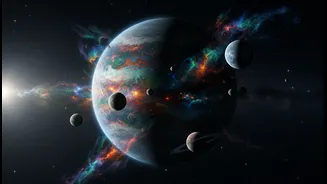
the worlds that emerge. Such violent events can completely strip a planet of its original atmosphere or deliver a new one. A massive collision heats a planet's interior, which in turn heats its gaseous envelope, making it vulnerable to being blown away into space. Imagine a billiard table where the balls don't just bounce off each other but merge, shatter, and throw off massive clouds of gas. The final arrangement of planets, and the atmospheres they retain, is a direct consequence of this early turbulence. A stable, orderly system like our own might be the result of a less tumultuous history, while other systems bear the atmospheric scars of a more violent upbringing.
Reading the Atmospheric Archive
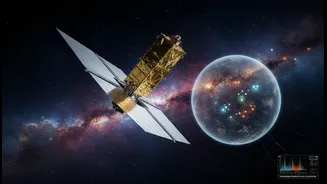
So, how can an atmosphere act as a history book? The key lies in its composition. The gases that make up a planet's air are a direct link to its formation and evolution. Scientists use a technique called transit spectroscopy. When an exoplanet passes in front of its host star from our point of view, starlight filters through its atmosphere. Different molecules and atoms absorb light at specific, signature wavelengths. By analyzing the starlight that reaches our telescopes, like the James Webb Space Telescope (JWST), astronomers can identify the chemical elements present. This process reveals a chemical fingerprint, telling us if the atmosphere is dominated by hydrogen and helium, like a gas giant, or contains heavier elements like water, carbon dioxide, or even vaporized rock. These fingerprints can then be connected to the planet's origin story.
The Chemical Clues to Chaos and Calm
The specific mix of elements tells a fascinating story. For instance, planets form within a disc of gas and dust around a young star. Different materials freeze at different distances from the star, creating so-called "ice lines." A planet that formed far out before migrating inward would have a different chemical makeup than one that formed close to its star. Its atmosphere might be rich in volatiles like water that could only have been accreted in a colder region. Furthermore, the presence of certain materials points to specific events. An atmosphere surprisingly rich in carbon monoxide, for example, could be the lingering evidence of a giant impact that occurred hundreds of thousands of years ago. In contrast, an atmosphere that seems to have a more primordial composition, similar to the star it orbits, might suggest a more peaceful formation with less planetary migration or fewer disruptive collisions.
From Theory to Observation
This exciting field is moving from theory to reality thanks to powerful new instruments. The James Webb Space Telescope has revolutionized our ability to study exoplanet atmospheres with unprecedented detail. It has already found strong evidence for an atmosphere around a rocky, ultra-hot super-Earth, a world previously thought incapable of retaining one. JWST has also observed planets that are actively losing their atmosphere due to intense heat from their star, giving us a real-time look at atmospheric evolution. Scientists can now compare the atmospheric compositions of planets within the same system or across different systems, looking for patterns. By studying planets of different ages, they can piece together a timeline of how atmospheres—and the stability of their systems—evolve over billions of years.