




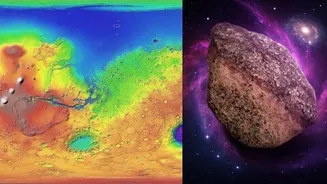
Mars's two small moons, Phobos and Deimos, have long puzzled scientists. Are they captured asteroids or remnants of a colossal impact on Mars? A key piece of NASA technology just delivered to an international partner aims to finally find out.
A New Set of 'Eyeglasses' for an Old Mystery
In a crucial
step for an ambitious international space mission, NASA has supplied a sophisticated science instrument to the Japan Aerospace Exploration Agency (JAXA). The instrument, known as MEGANE (Mars-moon Exploration with GAmma rays and NEutrons), is a gamma-ray and neutron spectrometer. Its name, pronounced 'meh-gah-nay', is the Japanese word for 'eyeglasses', a fitting name for a tool designed to 'see' the elemental composition of the Martian moon Phobos. Developed by the Johns Hopkins Applied Physics Laboratory (APL), MEGANE is a key US contribution to JAXA's Martian Moons eXploration (MMX) mission. Its delivery marks a significant milestone, allowing for integration with the MMX spacecraft ahead of its scheduled launch.
The Mission: A Daring Trip to the Martian Moons
The MMX mission is one of the most complex robotic explorations ever attempted. Led by JAXA, the spacecraft launched in October 2026 and will travel for about a year to enter orbit around Mars. From there, it will maneuver into a quasi-orbit around the larger moon, Phobos, studying both it and the smaller moon, Deimos, in unprecedented detail. The mission plan includes deploying a small French-German rover named Idefix to the surface of Phobos. The main MMX spacecraft will then land on Phobos, collect at least 10 grams of surface material—the first-ever sample from a Martian moon—and return it to Earth, with an expected arrival in 2031.
How to See a Moon's Composition
MEGANE's technology is at the heart of the mission's primary scientific goal. It doesn't take pictures in the traditional sense. Instead, it measures the energy of gamma rays and neutrons that are naturally emitted from Phobos's surface. These particles are created when the moon is bombarded by high-energy cosmic rays from deep space. Different chemical elements on the surface emit gamma rays and neutrons at distinct energy levels. By detecting these energy signatures, MEGANE can create a detailed map of the elements that make up Phobos, such as oxygen, silicon, iron, and hydrogen. This allows scientists to determine the moon's chemical makeup without even touching it, peering tens of centimeters beneath the surface.
Captured Asteroid or Martian Child?
The data collected by MEGANE will be instrumental in solving the primary riddle of Mars's moons: how did they form? Scientists have two main competing theories. One hypothesis is that Phobos and Deimos are former asteroids that strayed too close to Mars and were captured by its gravity. The other theory suggests they were formed from a cloud of debris blasted into orbit after a giant planet-sized object collided with Mars billions of years ago, similar to how Earth's Moon may have formed. If Phobos has a composition similar to asteroids found in the outer solar system, rich in water-related materials, it would support the capture theory. If its composition is closer to that of Mars's crust, it would point to a giant impact. MEGANE's elemental map will provide the critical evidence needed to distinguish between these two scenarios.
An International Partnership for Discovery
The MMX mission is a powerful example of modern, collaborative space exploration. While led by Japan, it features major contributions from several international partners. NASA is providing not only the MEGANE instrument but also a pneumatic sampling device and communications support through its Deep Space Network. The French and German space agencies, CNES and DLR, have partnered to build the Idefix rover. The European Space Agency (ESA) also provides communications and ground station support. This global teamwork allows for a more robust and capable mission than any single nation might mount on its own, pooling resources and expertise to answer fundamental questions about our solar system.