

More Than Just Packing Snacks
A round trip to Mars could take years. Simply packing enough food for astronauts is not a viable long-term strategy. The sheer weight and volume of pre-packaged meals would make the spacecraft impossibly heavy and expensive to launch. Furthermore, the nutritional
value of preserved food degrades over time, leaving astronauts vulnerable to deficiencies on multi-year journeys. This logistical nightmare has a clear solution, albeit a complex one: future Martian explorers must become farmers. Growing food on-site is essential for creating a self-sustaining presence on the Red Planet, reducing reliance on costly and impractical resupply missions from Earth.
A Hostile Environment for Growth
Farming on Mars is not as simple as planting a few potato seeds, despite what cinema might suggest. The planet presents a series of extreme challenges. The Martian 'soil', known as regolith, is not the life-filled dirt of Earth. It's a sterile, fine dust devoid of organic matter and essential nutrients like nitrogen needed for plants to thrive. Worse, it's laced with toxic perchlorate salts, which are harmful to both plants and humans. Beyond the soil, the thin atmosphere provides little protection from intense cosmic radiation, temperatures can plunge to -65°C, and the planet receives significantly less sunlight than Earth. Any Martian farm would need to be a highly controlled, pressurized, and shielded environment.
Lessons from Earth and Space
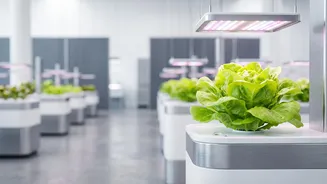
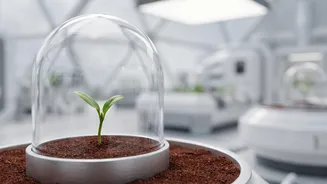
Scientists are already tackling these problems. On the International Space Station (ISS), NASA's Veggie and Advanced Plant Habitat experiments have successfully grown crops like lettuce, kale, and chile peppers. These projects test how plants react to microgravity and help refine the technologies needed for space agriculture. On Earth, researchers are using Martian regolith simulants to figure out how to remove the toxic perchlorates and add necessary nutrients, potentially using specific bacteria to make the soil viable. Advanced techniques like hydroponics and aeroponics, which grow plants without soil using nutrient-rich water or mists, are also key. These systems are incredibly water-efficient and are already being perfected for space missions.
The Unseen Benefit of Farming
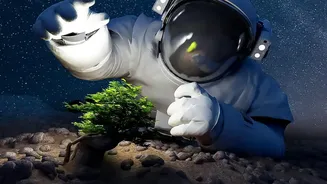
Beyond nutrition, growing plants has a profound psychological impact. Astronauts on long missions in sterile, isolated environments face significant mental stress. Studies from the ISS and analogous environments like Antarctic research stations show that gardening provides a tangible connection to life and nature. The simple act of caring for a living thing, watching it grow, and enjoying the sensory experience of fresh food provides a powerful morale boost, reduces stress, and combats the monotony of space travel. For the well-being of a future Mars crew, a small greenhouse could be as important as any other piece of equipment.
Innovations for Our Home Planet
The quest to farm on Mars is forcing a revolution in agricultural technology that has direct benefits back on Earth. The development of ultra-efficient, closed-loop systems for growing food is critical for a future with a changing climate and growing population. Technologies perfected for space, such as water-saving hydroponics, advanced LED lighting that tailors light recipes to specific plants, and automated vertical farming, are already being adopted. These innovations help us grow more food with less land, water, and energy, making them invaluable for urban farming and cultivating crops in harsh environments on our own planet. In essence, by learning to grow food in the most hostile environment imaginable, we are discovering how to be better, more sustainable farmers on Earth.