







A Perfect Place to Fly
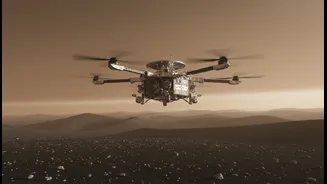
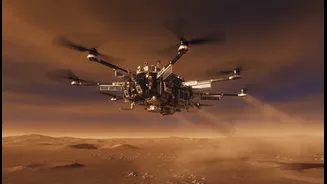
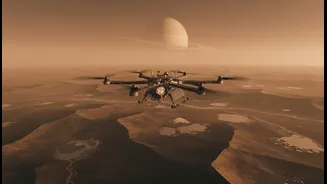
For decades, planetary exploration has meant either orbiting from above or crawling on the surface with rovers. Dragonfly represents a paradigm shift. It’s a car-sized, nuclear-powered dual-quadcopter, essentially a drone designed for another world. The
reason this is possible, and even preferable, on Titan comes down to two key factors: its atmosphere and its gravity. Titan's atmosphere, mostly nitrogen like Earth's, is about four times denser at the surface. Its gravity is only about one-seventh of Earth's. This combination of high-density air and low gravity makes flight incredibly efficient. In fact, it's estimated that it takes about 40 times less power to fly on Titan than on Earth, making it arguably the most flight-friendly body in the solar system.
From Crawling to Soaring
Rovers on Mars, like Curiosity and Perseverance, have been tremendously successful, but they are limited by terrain. A single large boulder or treacherous sandy patch can end a mission or force a long detour. Dragonfly completely bypasses these constraints. It can fly over dunes, craters, and other obstacles, covering dozens of kilometres in a single flight that might last under an hour. This gives it unprecedented mobility to explore a wide variety of locations. The mission plan involves flying from one scientifically interesting site to another, landing, conducting experiments, and then taking off again to the next destination. During its planned mission of over three years, Dragonfly is expected to travel more than 175 kilometres, a distance far greater than any rover has achieved on another world.
The Science of an Alien World
Titan is a world of incredible scientific interest. It is the only moon in our solar system with a thick atmosphere and standing bodies of liquid on its surface, in the form of methane lakes, seas, and rivers. Its atmosphere is rich with complex organic molecules that rain down onto the surface. Scientists believe Titan may hold crucial clues about prebiotic chemistry—the chemical steps that led to life on Earth. Dragonfly's primary goal is to investigate this chemistry. The rotorcraft is equipped with a suite of instruments, including a mass spectrometer to analyze the composition of surface materials and a drill to collect samples. By studying different locations, from the icy bedrock to the organic sand dunes, scientists hope to understand how far this prebiotic chemistry has progressed and whether Titan could have ever been habitable.
Engineering for a Frigid Frontier
Designing a craft to fly on Titan is not without its challenges. The surface temperature hovers around a frigid -179 degrees Celsius. Because it is so far from the Sun and under a hazy sky, solar power is not an option. Instead, Dragonfly will be powered by a Multi-Mission Radioisotope Thermoelectric Generator (MMRTG), the same type of nuclear power source used by the Curiosity rover on Mars. This provides a steady supply of heat and electricity, allowing the craft to operate for years. The mission will be highly autonomous. Due to the vast distance, the light-time delay for communications can be over an hour, meaning the craft must be able to navigate, identify safe landing spots, and conduct its science operations with minimal real-time input from Earth. Flights will occur roughly once every Titan day, which is equivalent to 16 Earth days, giving the craft ample time to recharge its batteries between hops.