





Why Almaty is Your Perfect Starting Point
Nestled at the foot of the snow-capped Tian Shan mountains, Almaty is more than just Kazakhstan's former capital; it's a living museum of history, culture, and design. For Indian travellers, the city offers an irresistible combination: direct flights,
a favourable exchange rate, and a 14-day visa-free stay. This makes it the most accessible and budget-friendly launchpad for exploring the unique architectural tapestry of the region. Here, styles from the Russian Empire, the Soviet Union, and the ancient Silk Road don't just coexist—they collide in the most spectacular ways, creating a cityscape unlike any other.
1. The Colours of the Silk Road
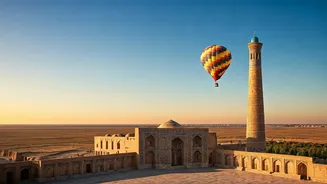
While Almaty is a relatively modern city, the spirit of the Silk Road, with its rich Islamic and Timurid influences, is very much alive. The best example is the Ascension Cathedral, also known as Zenkov Cathedral. Located in Panfilov Park, this isn't a mosque, but its candy-coloured onion domes and intricate wooden facade evoke the fairytale aesthetics of the region. It's one of the tallest wooden buildings in the world, famously constructed without a single nail. Nearby, the Almaty Central Mosque showcases more traditional Islamic architecture, with its grand blue dome, towering minarets, and detailed calligraphy, offering a peaceful counterpoint to the city's hustle.
2. The Grandeur of the Soviet Era
You cannot understand Almaty's landscape without appreciating its Soviet past. The city is a treasure trove for fans of Soviet Modernism and Brutalism. Start at the Kazakh-British Technical University, a monolithic structure that once housed the Supreme Soviet of the Kazakh SSR. Its imposing facade is a classic example of Stalinist architecture. For a more avant-garde experience, seek out the Hotel Kazakhstan, an icon of the skyline whose crown-topped peak is a symbol of the city. Walk along Dostyk Avenue to spot dozens of residential blocks and government buildings whose geometric patterns, mosaics, and stark concrete forms are a powerful reminder of a bygone utopian dream.
3. The Vision of Modern Kazakhstan
Since its independence, Kazakhstan has been forging a new national identity, and its architecture reflects this ambition. Almaty is dotted with gleaming glass-and-steel structures that often incorporate nomadic and natural motifs. The Almaty Metro is a must-see, not just for transport but for its palatial stations. Each station is a unique work of art, featuring marble, granite, and elaborate mosaics depicting Kazakh history and culture. It’s like a subway system designed by royalty, and a single token costs less than ₹50. Another key site is the Palace of the Republic, a concert hall renovated with a modern sensibility but which retains its iconic, swooping Soviet-era roof.
Making it Happen on a Budget
The “cheaply” in the headline is no joke. Flights from Delhi or Mumbai to Almaty are often competitively priced, especially when booked in advance. Once there, your money goes a long way. Use Yandex Go (the local Uber/Ola) for incredibly cheap rides around the city—a 15-minute trip rarely costs more than ₹200-₹300. Many of the architectural marvels can be admired for free from the outside, and entrance fees to places like museums and cathedrals are nominal. A hearty meal of local specialities like lagman noodles or beshbarmak can be found for just a few hundred rupees. Your biggest expense will be your flight; on the ground, Almaty is a paradise for budget-conscious explorers.