





Why Your Hips and Spine Are Aching
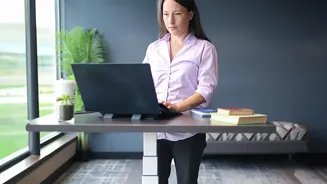
When you sit for extended periods, your body adapts to the position. Your hip flexors, the muscles at the front of your hips, become short and tight. Meanwhile, your glutes can become inactive and weak. This imbalance pulls your pelvis forward, creating
strain on your lower back. Simultaneously, your upper and middle back, or thoracic spine, tends to round forward as you hunch over your keyboard. Over time, this can lead to stiffness, poor posture, and persistent pain, affecting everything from your ability to stand up straight to simply walking without discomfort. The key to counteracting this is regular movement that takes your joints through their full range of motion.
Minutes 1-2: Cat-Cow for Spinal Warm-up
This classic yoga pose is the perfect way to gently awaken your spine. Start on your hands and knees, with your wrists directly under your shoulders and your knees under your hips. As you inhale, drop your belly towards the floor and look up, arching your back (Cow Pose). As you exhale, round your spine up towards the ceiling, tucking your chin to your chest (Cat Pose). Flow between these two positions for one to two minutes, synchronizing the movement with your breath. This simple action helps to increase the flexibility of the entire spine, from your neck down to your lower back, providing gentle relief and preparing it for deeper stretches.
Minutes 2-4: Thoracic Spine Rotations
Now, let's target the stiff middle back. From the same hands-and-knees position, place your right hand behind your head. Keeping your hips stable, rotate your upper body to the right, pointing your right elbow toward the ceiling. You should feel a stretch across your mid-back. Hold for a moment, then rotate back down, bringing your right elbow towards your left wrist. Perform 10-12 rotations on this side, then switch, placing your left hand behind your head and repeating the movement. This exercise specifically targets the thoracic spine's ability to rotate, which is often lost from constant hunching.
Minutes 4-6: Kneeling Hip Flexor Stretch
This is a gold-standard stretch for tight hip flexors. Kneel on your right knee, placing a cushion underneath it if needed. Step your left foot forward so your left knee is bent at a 90-degree angle. The crucial step is to tuck your pelvis under (imagine pulling your belt buckle towards your chin) and squeeze the glute on your right side. You should feel a stretch in the front of your right hip. For a deeper stretch, you can gently shift your weight forward. Hold for 30-60 seconds, breathing deeply. Switch legs and repeat on the other side.
Minutes 6-8: Seated Figure-Four Stretch
You don't even need to leave your chair for this one. Sit upright toward the edge of your chair with both feet flat on the floor. Cross your right ankle over your left knee, creating a 'figure four' shape. Keep your right foot flexed to protect your knee. You may already feel a stretch in your right hip and glute. To increase the intensity, gently press down on your right knee or hinge forward at your hips, keeping your back straight. Hold for 30-60 seconds, feeling the deep release. Then, uncross and repeat on the other side.
Minutes 8-10: Deep Squat Sit
Finish your routine with a movement that targets hips, lower back, and ankle mobility all at once. Stand with your feet slightly wider than your shoulders, with your toes pointed slightly out. Lower your hips down and back as if sitting in a low chair, going as deep as you can comfortably manage. Your goal is to get your hips below your knees. You can hold onto a desk or a doorframe for support. Try to keep your heels on the ground and your chest up. Hold this deep squat position for 60 seconds, gently rocking from side to side if it feels good. This pose helps to decompress the spine and open up the hips in a way that directly counters the seated posture.