



A Sweet Find Near the Galaxy's Heart
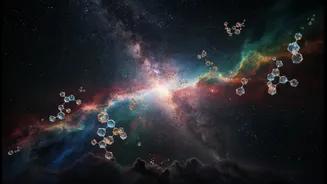
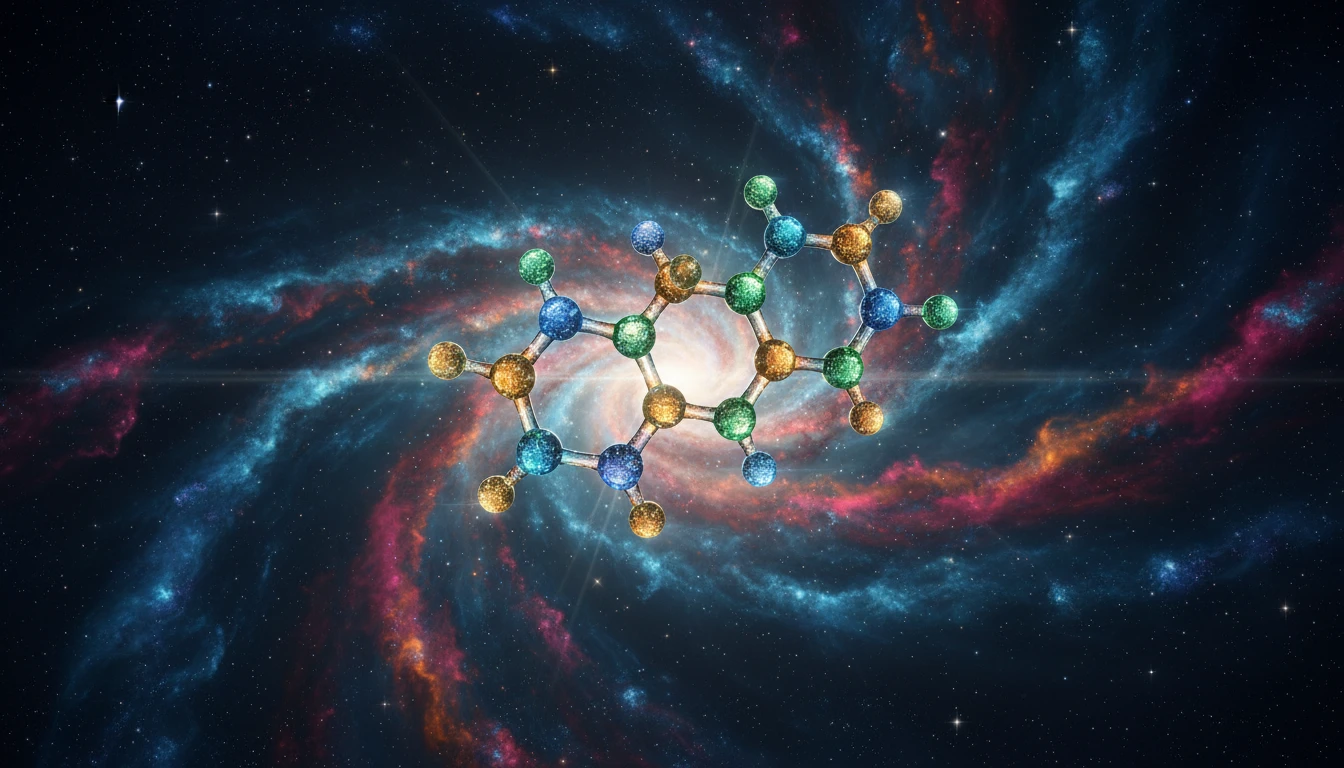
In a remarkable discovery, an international team of astronomers has detected a 'true sugar' molecule called erythrulose floating in a giant molecular cloud near the center of our Milky Way galaxy. Using powerful radio telescopes in Spain, researchers
identified the chemical signature of this four-carbon sugar, which on Earth is found in raspberries, சுமார் 27,000 light-years away. While sugar-related molecules have been found in meteorites before, this is the first direct detection of a true sugar in the interstellar medium—the thin gas and dust that exists between stars. This is significant because these molecular clouds are the birthplaces of stars and their planetary systems.
Not Your Kitchen Sugar
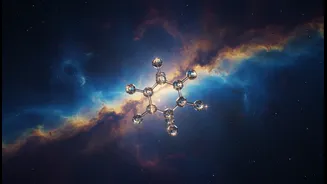
When scientists talk about finding sugar in space, they're not referring to the sucrose you stir into your coffee. Erythrulose is a monosaccharide, a simple sugar, but it's a crucial one from a biological perspective. Sugars are fundamental building blocks for life as we know it. They form the structural backbone of RNA and DNA, the molecules that carry genetic instructions, and are essential for metabolic processes that provide energy to cells. The discovery of erythrulose is particularly exciting because it can easily convert into other sugars that are considered possible precursors to the very first genetic molecules, like RNA, on a young planet.
Rewriting the Recipe for Life
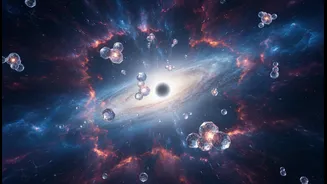
For a long time, scientists have debated how the first sugars, necessary for life to begin, appeared on early Earth. Laboratory experiments that try to replicate the conditions of our primitive planet often struggle to produce sugars in sufficient quantities. This discovery provides strong evidence for an alternative source: space. Finding erythrulose in a stellar nursery suggests that these essential ingredients aren't made on planets, but are cooked up in the cosmos and are already present in the material from which planets form. The research team estimates that millions of tonnes of this sugar could have been delivered to a young Earth during the 'Late Heavy Bombardment' period, when comets and asteroids constantly rained down.
A Cosmic Chemistry Puzzle
The finding also presents a fascinating new puzzle for astrochemists. The prevailing theory was that complex molecules in space form incrementally, by adding one carbon atom at a time. However, the team found that erythrulose, a four-carbon sugar, was significantly more abundant than any simpler, three-carbon sugars in the same cloud. This unexpected result suggests that a different chemical pathway might be at play. The researchers propose that erythrulose may form from the combination of simpler two-carbon molecules on the icy surfaces of dust grains, challenging previous models of interstellar chemistry.
The Search for Our Cosmic Origins
This sweet discovery fundamentally shifts our understanding of where the building blocks of life come from. It implies that the raw materials for biology are not a rare occurrence unique to our planet but may be common throughout the galaxy. If sugars and other prebiotic molecules are widely available in the clouds where stars and planets are born, it raises the tantalizing possibility that the ingredients for life are sprinkled across countless nascent solar systems. Scientists are now planning to search for even more complex sugars, like ribose, the very sugar that forms the backbone of RNA. Each detection brings us a step closer to answering one of humanity’s oldest questions: are we alone in the universe?