




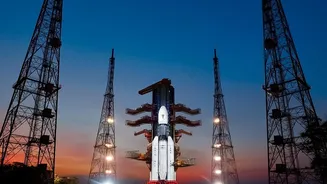
Meet Pushpak, India’s Space Shuttle
At the heart of India's quest for cheaper space access is the Reusable Launch Vehicle (RLV), nicknamed 'Pushpak'. Unlike conventional rockets that are discarded after a single use, Pushpak is designed like a spaceplane. It’s a winged vehicle built to
travel to space, deploy satellites, and then fly back to Earth, landing horizontally on a runway just like an aircraft. This reusability is the key to revolutionizing launch economics. The most expensive parts of a rocket are its complex engines and structures, which can account for up to 80% of the total cost. By recovering and reusing this hardware over multiple missions, ISRO aims to slash the cost of putting a satellite into orbit, potentially by as much as 80-90%.
Nailing the Perfect Landing
The most crucial technology for a reusable spaceplane is the ability to land autonomously and safely. ISRO has been proving this capability through a series of Landing Experiments (LEX). In recent trials at the Aeronautical Test Range in Chitradurga, Karnataka, Pushpak has achieved a hat-trick of successful autonomous landings. In these tests, the winged vehicle is lifted to an altitude of 4.5 kilometres by an Indian Air Force Chinook helicopter and then released. From there, Pushpak must navigate on its own. It performs complex manoeuvres to correct its path, approaches the runway at high speeds of over 320 kmph, and executes a precise, controlled landing on the centreline. The vehicle uses a combination of a brake parachute and its landing gear brakes to come to a safe halt.
Smarter, Tougher, and More Precise
Each landing experiment has been progressively more challenging. The most recent test, LEX-03, subjected Pushpak to more severe wind conditions and released it further off-course, forcing it to make more significant autonomous corrections to find the runway. These tests validate ISRO's mastery of the critical technologies required, including advanced navigation and control systems, and durable landing gear. Impressively, the same winged body and flight systems from the second mission (LEX-02) were reused for the third (LEX-03) without modification, demonstrating the robustness and reusability of the hardware. The vehicle’s sophisticated guidance system relies on a suite of indigenous sensors, including India's own NavIC satellite navigation system, to achieve its remarkable precision.
Why Reusability is a Game-Changer
Mastering reusability positions India and ISRO as a highly competitive player in the multi-billion dollar global satellite launch market. Lower costs make space more accessible for a wider range of applications. It opens the door for deploying large satellite constellations for communication and Earth observation, enables more frequent scientific missions, and allows smaller companies and developing nations to access space. For India, it’s a crucial step towards self-reliance and achieving its ambitious space goals, including the establishment of the 'Bhartiya Antariksha Station' (Indian Space Station) by 2035. ISRO chairman S. Somanath has described Pushpak as India's bold attempt to make space access more affordable.
The Road Ahead: From Landing to Orbit
The successful completion of the landing experiment series is a major milestone, but it's not the final step. The next phase for the program is the Orbital Re-entry Experiment (ORE). In this future mission, a larger version of the vehicle will be launched into a 400-km orbit around Earth using a modified GSLV rocket. After spending time in orbit, it will perform a controlled re-entry through the atmosphere, enduring extreme temperatures, before returning to land autonomously on a runway. This will be the ultimate test of the vehicle's design and thermal protection systems, bringing ISRO one giant leap closer to an operational, fully reusable two-stage-to-orbit launch vehicle.