





The Foundation: Sholay (1975)
Before the term “pan-Indian” was coined, there was 'Sholay'. While not a pan-Indian release in the modern sense, its influence was felt nationwide. Directed by Ramesh Sippy, this definitive curry-western established a benchmark for action cinema in India.
Its grand scale, iconic villain Gabbar Singh, and the legendary duo of Jai and Veeru created a cultural phenomenon that transcended regional markets, proving that a well-told, high-stakes action drama could unite the country in front of the big screen. It blended Hollywood-inspired action sequences with deeply Indian emotional storytelling, creating a template that many films would follow for decades.
The Game-Changer: Baahubali Series (2015-2017)
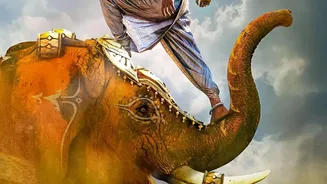
S.S. Rajamouli's 'Baahubali' duology is widely credited with pioneering the modern pan-Indian film movement. These films were not just movies; they were events that shattered the notion that only Hindi films could achieve nationwide success. By investing in world-class VFX, epic-scale storytelling rooted in Indian mythology, and a strategic multi-language release, 'Baahubali' proved that a Telugu film could dominate the national conversation and box office. The cliffhanger at the end of the first film—"Why did Kattappa kill Baahubali?"—became a national obsession, demonstrating the power of serialized, high-concept storytelling. The success of 'Baahubali 2', which became the highest-grossing Indian film at the time, cemented the pan-Indian model as a viable and highly lucrative strategy.
The Stylistic Innovator: K.G.F. Series (2018-2022)
If 'Baahubali' opened the door, Prashanth Neel's 'K.G.F: Chapter 1' stormed right through it. Hailing from the Kannada film industry, 'K.G.F.' brought a new aesthetic to the pan-Indian landscape. It traded mythical fantasy for a gritty, hyper-stylized underworld saga. The film's protagonist, Rocky Bhai, became an instant icon, resonating with audiences through his swagger and anti-establishment rage. 'K.G.F.'s unique visual grammar, characterized by slick editing and a monochromatic colour palette, offered a darker, more modern take on the action hero. Its massive success demonstrated that the pan-Indian appetite was not just for epic fantasies but also for stylish, character-driven action dramas.
The Rustic Powerhouse: Pushpa: The Rise (2021)
Allu Arjun's 'Pushpa: The Rise' proved that pan-Indian success didn't always require a colossal budget or mythological scale. Instead, its power came from its raw, rustic authenticity and an unforgettable lead character. Set against the backdrop of red sandalwood smuggling, the film's gritty action and Allu Arjun’s charismatic performance as the unapologetically ambitious Pushpa Raj struck a chord across the country. His iconic hand gesture and dialogues went viral, showing that a strong, culturally-rooted story with a compelling anti-hero could captivate audiences just as effectively as a visual effects spectacle. 'Pushpa' solidified the idea that hyper-local stories could have pan-Indian appeal if the character and emotion were universal.
The Global Spectacle: RRR (2022)
After creating the pan-Indian blueprint with 'Baahubali', S.S. Rajamouli returned with 'RRR' and took the concept global. A fictionalized account of two real-life revolutionaries, the film was a maximalist celebration of brotherhood, action, and anti-colonial sentiment. The action sequences were inventive and emotionally resonant, from the wild animal attack on the British governor's mansion to the show-stopping 'Naatu Naatu' dance number. 'RRR' didn't just succeed in India; it became a global phenomenon, winning an Oscar and proving that an Indian film, rooted in its own culture and history, could entertain audiences worldwide without compromise. It represented the ultimate evolution of the pan-Indian film—a movie made in India, for the world.