




Beyond the Pretty Picture
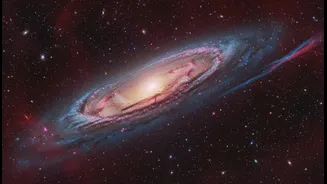
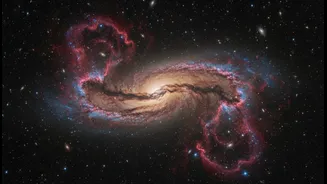
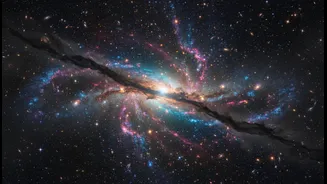
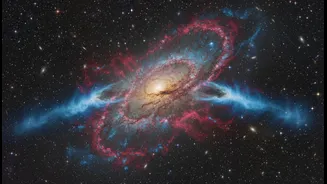
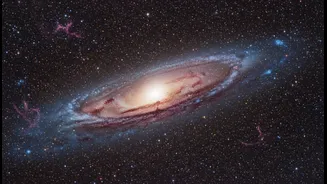
To celebrate its fourth year of operations, NASA has released an astonishing new view of Centaurus A, a galaxy relatively close to us at about 11 to 13 million light-years away. The image is a breathtaking tapestry of glowing gas, intricate dust lanes,
and millions of individual stars. It's easy to get lost in the sheer spectacle. Yet, to treat it merely as cosmic eye-candy is to miss the point entirely. This image isn't just a snapshot; it's a data-rich historical document that astronomers are using to perform galactic archaeology, peeling back layers of time to understand how galaxies evolve, interact, and die.
A Galaxy with a Violent Past
Centaurus A is not your average, quiet galactic neighbor. It's known as an active galaxy, meaning its core is unusually bright and energetic. At its heart lies a supermassive black hole, about 55 million times the mass of our sun, that is actively feeding on surrounding gas and dust. As it consumes this material, it blasts out powerful jets of high-energy particles at nearly half the speed of light. The galaxy's peculiar shape is the result of a violent collision about two billion years ago, when a large elliptical galaxy merged with a smaller spiral galaxy. This cosmic crash left behind the dramatic, dark dust lane that famously bisects the galaxy in visible-light photos.
What Webb Sees That Hubble Can't
Previous images from telescopes like Hubble have shown us the stark beauty of Centaurus A but were limited. The thick, dark band of cosmic dust that gives the galaxy its signature look also acted like a curtain, blocking visible light from revealing what was happening inside. This is where the James Webb Space Telescope's power comes in. By observing in infrared light, Webb can peer through the obscuring dust as if it were translucent. Where Hubble saw a dark void, Webb reveals a hive of activity: a warped disc of warm gas, glowing filaments, and countless individual stars that were previously hidden from view. It's like having X-ray vision for the cosmos.
Reading the Stellar Fossil Record
One of the most significant breakthroughs from this new image is Webb's ability to resolve millions of individual stars, even within the galaxy's densely packed core. What might look like a grainy texture in the image is actually a field of separate stars. Each star is a time capsule. By studying their types and locations, astronomers can reconstruct the galaxy's history. They can identify older stars that existed before the great merger, pinpoint a burst of star formation that occurred during the collision, and map out the younger stars born from the aftermath. This turns the image into a timeline, allowing scientists to piece together the sequence of this galaxy's dramatic life story.
Understanding the Central Engine
The new Webb data also provides an unprecedented look at the relationship between the supermassive black hole and its host galaxy. Scientists can now see in greater detail how gas and dust are funneled toward the black hole, feeding it and powering its energetic jets. They can also study how those same jets influence the rest of the galaxy—in some areas, they compress gas to trigger new waves of star birth, while in others they blow the raw material away, effectively halting the process. This delicate and violent interplay is key to understanding how a galaxy's central engine can both give life and take it away, and Centaurus A is our closest laboratory for studying this phenomenon.