





Saturn's Temporary Crown
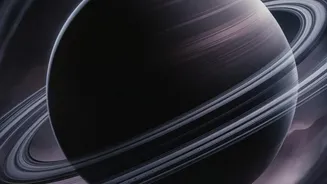
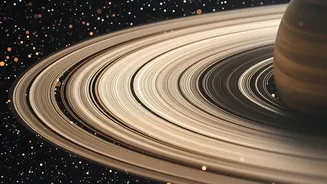
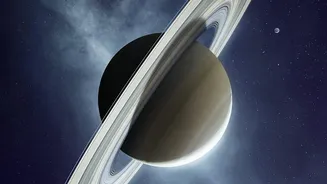
For a long time, astronomers assumed Saturn's magnificent rings were as old as the planet itself, which formed about 4.5 billion years ago. However, data from NASA's Cassini spacecraft, which studied Saturn for 13 years, has painted a very different picture.
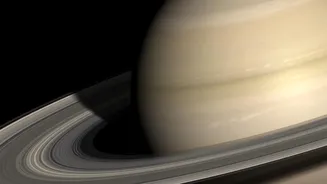
Evidence now strongly suggests the rings are newcomers, likely forming no more than 100 to 400 million years ago. This means they may have appeared while dinosaurs still roamed the Earth. The key evidence lies in their composition. The rings are made of almost 99% pure water ice, with particles ranging from the size of dust grains to large boulders. If they were ancient, they would be much darker and dirtier, having been polluted by a constant rain of micrometeoroids over billions of years. Their brightness points to a much younger age.
The Inevitable 'Ring Rain'
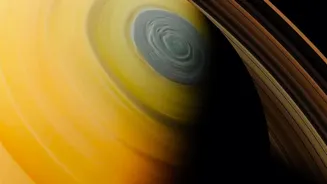
Not only are Saturn's rings young, but they are also disappearing. The same Cassini mission that helped determine their age also discovered a phenomenon dubbed 'ring rain'. Pulled by the planet's immense gravity and influenced by its magnetic field, tons of ring material—mostly icy particles—are being drawn into Saturn's upper atmosphere every second. This downpour is significant enough that scientists estimate the entire ring system could be gone in as little as 100 million years, and will certainly be much less impressive in the coming tens of millions of years. We are incredibly fortunate to live in an era where Saturn's rings are so spectacular. In another few hundred million years, they may be just a faint whisper of their current glory.
The Faint and Dusty Rings of Jupiter and Neptune
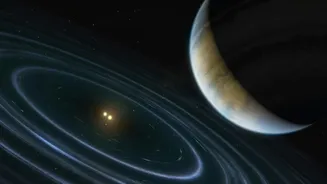
In stark contrast to Saturn's icy spectacle, the other giant planets in our solar system—Jupiter, Uranus, and Neptune—also have rings, but they are much fainter and harder to see. Jupiter's rings, for instance, are thin and composed mainly of dust. These are believed to be very young, perhaps only a few million years old, and are constantly being replenished. The source of this material is thought to be Jupiter's inner moons, which shed dust when struck by tiny meteoroids. Similarly, Neptune's rings are dark, faint, and dusty. Like Jupiter's, they are considered relatively young and are likely the result of collisions fragmenting former inner moons, with the resulting debris forming the rings we see today.
Uranus: Home to Ancient, Dark Rings?
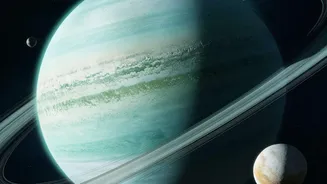
The ring system of Uranus presents yet another story. Its rings are not bright and icy like Saturn's, but remarkably dark, composed of material that reflects very little light. Scientists believe this dark material consists of organic compounds processed by radiation over a very long time. While the exact age is still debated, some estimates place their formation around 600 million years ago, but it's also possible they are much older, having persisted for billions of years. Unlike Saturn's massive rings, which are actively eroding, the longevity of Uranus's dark rings might be due to recycling processes where material is recaptured and re-formed into moons and back into rings over vast timescales. This suggests that while individual ring particles have short lives, the system as a whole can endure.
A Cycle of Creation and Destruction
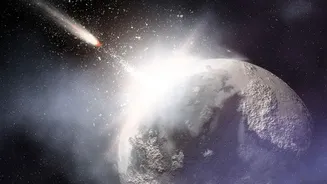
The lifespan of a planetary ring system boils down to a cosmic battle between creation and destruction. Rings are born from dramatic events, such as an icy moon straying too close to its planet and being torn apart by gravity, or from collisions between moons. Once formed, they are immediately under assault. Micrometeoroid bombardment pollutes them and grinds down particles. Gravity and magnetic fields pull material onto the planet. The key difference in longevity comes down to mass and replenishment. A massive system like Saturn's can shine brightly for hundreds of millions of years before fading. Fainter, dustier rings like Jupiter's only persist because they are constantly being fed new material from nearby moons. The ancient, dark rings of Uranus may represent a more stable, long-term state.