




The Challenge of Dynamic Range
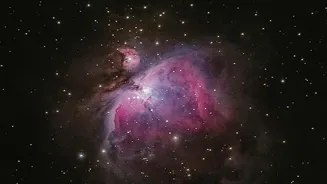
The heart of the problem lies in what photographers call dynamic range. A galaxy like Andromeda (M31) has an intensely bright, dense core and incredibly faint, sprawling spiral arms. Your camera's sensor, no matter how advanced, struggles to capture both
these extremes in a single shot. If you expose for the faint arms, the core becomes a white, detail-less blob. If you expose for the core, the beautiful outer structures disappear into the blackness of space. This is the classic dilemma astrophotographers face. The solution isn't one perfect setting, but a combination of different exposures.
Rethinking the Exposure Triangle
In standard photography, you balance aperture, shutter speed, and ISO for a single correct exposure. For a high-dynamic-range subject like a galaxy, you must use these tools differently. Aperture is simple: you'll almost always use your lens's widest setting (the lowest f-number) to gather as much light as possible. ISO will be moderately high (e.g., 800-3200) to make the sensor sensitive, but not so high that it introduces excessive noise. Shutter speed is where the real magic happens. Instead of one shutter speed, you will use several.
Short Exposures for the Bright Core
The first step in the capture process is to preserve the detail in the galaxy's core. To do this, you need to take a series of very short exposures. Depending on your telescope or lens, these could be anywhere from 15 to 60 seconds long. The goal here is to capture the structure, dust lanes, and star clouds near the nucleus without letting them clip to pure white. You will take many of these short exposures—perhaps 15 to 20 of them—which will later be stacked together in software to improve the signal-to-noise ratio for a clean, detailed core image.
Long Exposures for Faint Details
Once you have your 'core' shots, it's time to capture the faint, ethereal arms and dust lanes. This requires a new set of much longer exposures. Here, you might shoot for 3, 5, or even 10 minutes per exposure, depending on the accuracy of your star tracker and the darkness of your skies. These long captures are designed to gather the faint photons from the galaxy's outer edges. The core will be completely blown out in these images, and that's okay. Their purpose is to record the details you couldn't get with the shorter exposures. Again, you will take many of these long-exposure frames.
Blending in Post-Processing
This two-part capture strategy results in two separate sets of images: a collection of short exposures for the core and a collection of long exposures for the arms. The final step is to combine them in post-processing software like PixInsight, Siril, or Adobe Photoshop. First, you stack each set independently to create two master images: one with a perfect core and dark surroundings, and another with faint arms and a blown-out core. Using layer masks, you can then blend them. You essentially place the detailed core from the first image into the centre of the second image, creating a single, seamless photo with a massive dynamic range that looks natural and reveals detail from the brightest to the dimmest parts of the galaxy.