




Just How Slow Is It?
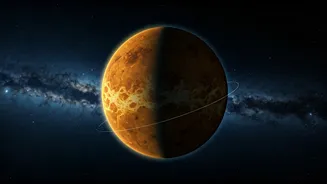
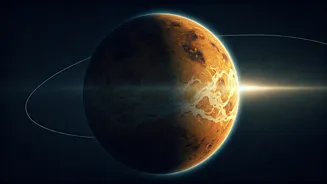
Prepare to have your mind warped. A single day on Venus—the time it takes for the planet to complete one full rotation on its axis—is 243 Earth days long. To put that in perspective, the Earth, as we know, takes just 24 hours. This makes Venus the slowest-rotating
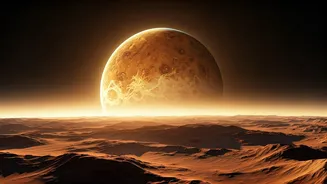
planet in our entire solar system. If you could stand on its surface (which you can't, due to the crushing pressure and scorching heat), the sun would appear to move across the sky at a glacial pace. This sluggish spin is not just a quirky trivia point; it’s a fundamental characteristic that shapes the planet’s extreme environment and makes it one of the most fascinating objects of study for planetary scientists.
A Day Longer Than a Year
Here is the fact that often goes viral, and for good reason: a day on Venus is longer than its year. Let’s break that down. While it takes Venus 243 Earth days to spin once on its axis (a sidereal day), it only takes about 225 Earth days to complete one full orbit around the Sun (a Venusian year). Yes, you read that correctly. On Venus, the planet completes its annual journey around the sun before it even finishes a single day's rotation. This leads to another strange effect. The time from one sunrise to the next, known as a solar day, is about 117 Earth days. So, if you were born on Venus, you'd celebrate your first birthday before you even experienced your first full sunrise and sunset cycle.
Spinning the Wrong Way
As if being the solar system's slowest spinner wasn't enough, Venus also spins backward. Most planets in our solar system, including Earth, have a prograde rotation, meaning they spin counter-clockwise on their axis when viewed from above the North Pole. This is the same direction in which they orbit the sun. Venus, however, has a retrograde rotation, spinning clockwise. The only other major planet with a retrograde rotation is Uranus, which is tilted so far on its side it's practically rolling along its orbit. This backward spin means that on Venus, the Sun rises in the west and sets in the east. This unusual characteristic adds another layer to the mystery of how Venus evolved into the planet we see today.
Why is Venus So Weird?
Scientists don't have a single, definitive answer for Venus's slow, retrograde rotation, but they have some compelling theories. One leading hypothesis suggests that early in its history, Venus was struck by a massive asteroid or protoplanet. Such a cataclysmic impact could have been powerful enough to not just halt its original spin but actually reverse it, leaving it with the slow, backward rotation we observe. Another theory focuses on Venus’s incredibly thick and heavy atmosphere—90 times denser than Earth's. Over billions of years, the friction caused by this dense, churning atmosphere and the gravitational pull of the Sun could have created atmospheric tides that acted like a brake, slowing the planet’s rotation down to its current crawl. It’s possible a combination of these factors is responsible.
How We Cracked the Code
Observing Venus's rotation wasn't easy. The planet is perpetually shrouded in a thick layer of sulfuric acid clouds, making it impossible to see its surface with conventional telescopes. The breakthrough came with the advent of radar astronomy. By bouncing powerful radar signals off Venus from Earth-based observatories like the Arecibo Observatory and Goldstone Solar System Radar, scientists could 'see' through the clouds. They tracked surface features like mountains and craters over time to precisely measure the speed and direction of the planet's spin. Later, missions like NASA's Magellan spacecraft used radar to map over 98% of the planet's surface in detail, confirming these ground-based measurements and giving us the incredible data we have today.