


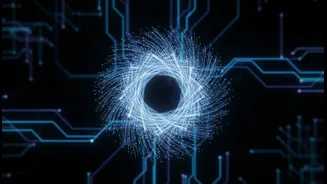


First, What Are Skyrmions?
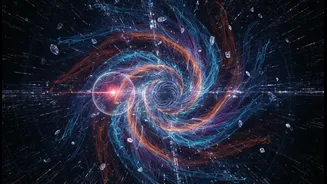
Imagine a tiny, self-contained vortex or a microscopic smoke ring. That's a helpful way to think about a skyrmion. First theorised in the 1960s for particle physics, they were later found in magnetic materials. A skyrmion is a stable, particle-like swirl
in a field—in this case, the field of magnetism. Their structure is incredibly robust; you can't easily 'untie' them, which makes them topologically protected. Scientists realised this stability could be perfect for storing data. You could represent a '1' with the presence of a skyrmion and a '0' with its absence, creating a new form of digital memory that is incredibly small and energy-efficient. More recently, researchers have been exploring 'optical skyrmions'—the same kind of stable, swirling pattern, but made of light itself.
The 200-Year-Old Light Trick
The second half of this discovery involves a phenomenon with a fascinating history: the Poisson spot, also known as the Arago spot. Back in 1818, French physicist Augustin-Jean Fresnel submitted a paper arguing that light behaves like a wave. Siméon Poisson, a judge for the competition and a supporter of the theory that light was a particle, was deeply sceptical. He calculated that if Fresnel's wave theory were true, a bizarre thing would happen: if you shine a light at a perfectly round obstacle, a bright spot should appear in the very centre of its shadow. Poisson presented this as an absurd conclusion to disprove the wave theory. However, another scientist, François Arago, decided to actually perform the experiment. To Poisson's shock, the bright spot appeared exactly as predicted, providing powerful proof that light does indeed behave like a wave.
Bringing Old and New Together
Researchers at Nanyang Technological University (NTU) in Singapore decided to revisit this classic experiment with modern tools. Instead of simply observing the Poisson spot, they carefully analysed all the properties of the light that formed it. By shining a laser beam at a tiny circular disc, they not only created the famous bright spot but found that the light within that spot and its surrounding rings naturally arranged itself into complex, swirling patterns. These patterns were the elusive optical skyrmions. The team discovered that by simply using this 200-year-old setup, they could generate not just one, but four different types of optical skyrmions at the same time, related to the light's electric field, magnetic field, polarisation, and spin.
Why This Breakthrough Is a Big Deal
Until now, creating optical skyrmions has been a difficult and expensive process. It often required fabricating complex, microscopic structures called metamaterials to twist light in just the right way. The NTU team's discovery provides a surprisingly simple, cheap, and accessible alternative. According to Assistant Professor Shen Yijie, who led the research, this lowers the technical barrier for scientists around the world to create and study these structures. Making optical skyrmions easier to produce could dramatically accelerate research into their potential applications. These are not just scientific curiosities; they are seen as key components for the future of computing and communications. Their stability and small size make them ideal candidates for ultra-high-density data storage and super-fast, light-based information processing, often called photonic systems.
The Road Ahead for Light-Based Tech
This discovery is a foundational step, but a crucial one. The ability to easily generate and control these tiny light-based whirlpools opens the door to a new wave of innovation. The next steps will involve refining the process and exploring how to manipulate these optical skyrmions to encode, store, and retrieve information. While 'racetrack' memories using magnetic skyrmions have been a research goal for years, using light could offer even greater speeds. This blend of classic physics and modern photonics shows how even centuries-old knowledge can unlock future technologies. It's a powerful reminder that the next great leap forward in technology might be hiding in a textbook experiment, just waiting for a fresh perspective to reveal its full potential.