



For generations, gold has been seen as the ultimate safe investment, a precious metal whose value only ever goes up. But the long-held belief that gold delivers guaranteed positive returns every single year is a comforting myth, not a reality.
The Golden Myth of Unbroken Growth
In India,
gold is more than just an investment; it is a cultural cornerstone, a symbol of prosperity, and a trusted store of value passed down through generations. This deep-seated faith fuels a powerful assumption: that the price of gold is on a perpetual, uninterrupted climb. Many investors buy gold with the expectation that, regardless of economic conditions, their asset will be worth more next year than it is today. This belief paints gold as a magical asset, immune to the volatility that affects stocks, bonds, and currencies. But while gold has delivered impressive long-term returns, its journey has been far from a smooth, straight line pointing upwards.
Reality Check: The Years Gold’s Price Fell
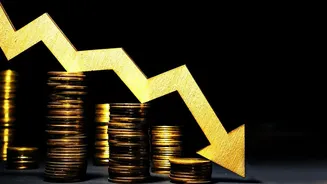
A look at historical data quickly dispels the myth of an endless ascent. Since its famous peak in 1980, gold has experienced several significant downturns. After hitting a high of around $850 per ounce in January 1980, the price fell later that year. In fact, the two decades that followed were largely a bear market for the metal. Between 1980 and 2000, investors who bought at the peak would have lost a substantial amount of their investment's purchasing power. There have been many other notable down years and periods. For instance, the price fell by more than 25% in 1981. Between 2011 and 2015, gold lost about 45% of its value, and 2013 was a particularly punishing year for investors. These periods demonstrate that gold is subject to market forces and multi-year cycles, just like any other asset.
What Actually Drives the Price of Gold?
If not by magic, what determines the price of gold? The answer lies in a complex interplay of global economic factors. The most significant drivers include interest rates, the strength of the US dollar, inflation expectations, and geopolitical uncertainty. Gold is priced in US dollars, so when the dollar strengthens against other currencies, it takes fewer dollars to buy an ounce of gold, often pushing its price down. Conversely, a weaker dollar tends to boost gold prices. Central bank policies are also critical; when central banks raise interest rates, non-yielding assets like gold become less attractive compared to bonds that offer regular interest payments.
Rethinking the ‘Safe Haven’
Gold's reputation as a 'safe haven' is often misunderstood. It doesn't mean it's safe from price drops. Rather, it means investors flock to it during times of crisis—like a pandemic, war, or major financial instability—seeking to protect their wealth from currency devaluation or stock market crashes. During the 2008 financial crisis and the 2020 COVID-19 pandemic, gold prices surged as uncertainty peaked. Its value lies not in guaranteed annual growth, but in its tendency to perform well when other assets are failing. It acts as a form of portfolio insurance, but like all insurance, it has its own costs and cycles.
What This Means for Indian Investors
Understanding gold's true nature is crucial for a sound investment strategy. For Indian investors, gold remains an excellent tool for portfolio diversification and a long-term hedge against inflation. Over decades, it has proven its ability to preserve purchasing power. However, it should not be treated as a short-term, get-rich-quick scheme. The data shows that timing the market is difficult, and buying at a peak can lead to years of waiting just to break even in nominal terms. A prudent approach is to allocate a portion of one's portfolio (often suggested at 5-15%) to gold as a long-term holding, designed to provide stability and balance rather than spectacular year-on-year gains.