





A Planet on the Clock
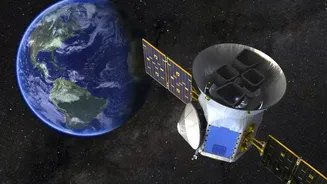
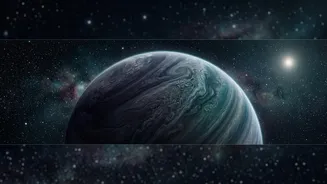
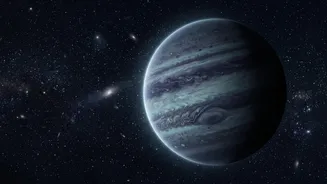
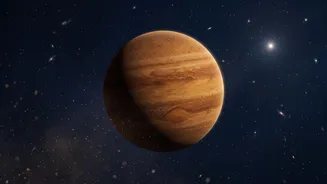
For seven years, from 2019 to early 2026, the exoplanet known as TOI-2535 b was a regular, if slightly odd, celestial neighbor. Discovered by NASA's Transiting Exoplanet Survey Satellite (TESS), this 'hot Jupiter' is a gas giant that orbits its star in a blistering
8.25 days. Astronomers detect such planets using the transit method: when a planet passes directly between its star and Earth, it causes a tiny, periodic dip in the star's brightness. But TOI-2535 b was never perfectly on schedule. Its transits would sometimes arrive up to six hours early or late, a significant deviation that hinted something was amiss in the system. Then, in March 2026, the planet stopped showing up at all. The expected dimming of its star's light never came. TOI-2535 b had, from our perspective, vanished.
The Wobble in the System
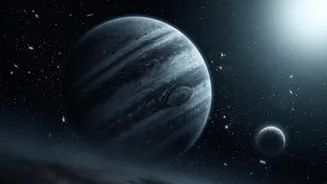
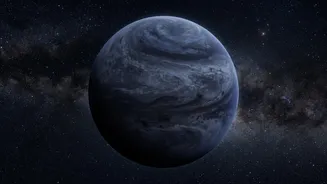
Planets don't just get destroyed or disappear. The solution to the mystery lies in the erratic timing that preceded its disappearance. Those six-hour variations in its transit were a tell-tale sign that TOI-2535 b was not alone. Scientists theorized that the gravitational pull of another, unseen planet was tugging on it. A research team led by astronomers at UCLA confirmed this, proposing that a massive, hidden companion is locked in a gravitational dance with TOI-2535 b. This companion is likely a planet at least the mass of Saturn, and its orbit is tilted relative to TOI-2535 b's. This mutual gravitational pull causes the orbital planes of both planets to wobble, a phenomenon known as nodal precession. Imagine two spinning tops near each other; their gravitational interaction makes them both wobble as they spin. That's what's happening in this distant solar system.
Not Gone, Just Out of Sight
This orbital wobble is the key. The transit method only works when a planet's orbit is perfectly aligned with our line of sight to its star. As the orbit of TOI-2535 b wobbled, its path across the face of its star shifted. Observations showed its transit getting shorter and shallower before it disappeared entirely. The wobble eventually tilted its orbital plane just enough that, from Earth, it no longer crosses in front of its star. The planet is still there, faithfully orbiting its sun, but it is now hidden from our primary method of detection. It's the first time astronomers have directly observed a planet's transit cease due to this rapid orbital tilting. As one researcher noted, the planet's orbit tilted so quickly that its transit disappeared while they were watching.
What This Cosmic Disappearance Teaches Us
This discovery does more than just solve a cosmic puzzle; it provides a rare, real-time look at how planetary systems evolve. It challenges the idea of solar systems as perfect, clockwork mechanisms, revealing them to be dynamic and interactive places. The presence of two giant planets so close together also offers clues about how 'hot Jupiters' form. These massive planets are thought to form far from their stars and migrate inwards. A violent migration would likely have ejected one of the planets, so the fact that two remain suggests a slower, more gentle spiral into their current orbits. The extreme tilt between them, however, shows that even these calmer systems can be dynamically reshaped over time. Scientists estimate that TOI-2535 b won't transit its star again for another 30 to 50 years, though its hidden neighbor might just wobble into our line of sight sooner.