



Why Good Posture Is More Than Standing Straight
Posture is the foundation of every move you make. When your body is properly aligned, it functions with greater efficiency, reducing strain on muscles and joints. Good posture isn't about maintaining a rigid, unnatural stiffness; it's about finding a dynamic
balance that supports your spine. The benefits extend beyond the physical, too. Standing tall can improve breathing by opening up the chest, boost confidence and energy levels, and even enhance your mood. Conversely, habitual slouching can lead to muscle tension, reduced lung capacity, and a general feeling of fatigue. Building postural awareness is the first step toward reclaiming your body’s natural, powerful alignment.
Meet Tadasana: The Blueprint for All Standing Poses
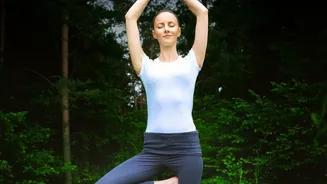
Tadasana, which translates from Sanskrit as 'Mountain Pose', may look like you are simply standing still, but it is an active and engaged posture. It is considered the blueprint for all other standing poses in yoga because it teaches the fundamentals of grounding, stability, and spinal alignment. While often used as a starting or transitional pose, practicing Tadasana on its own is a powerful way to check in with your body, correct imbalances, and cultivate a sense of groundedness and presence. The pose trains you to feel steady, solid, and unmoving like a mountain, creating a connection that is both physical and mental.
Building Your Mountain from the Ground Up
Proper alignment in Mountain Pose starts with your foundation: the feet. Begin by standing with your big toes touching and heels slightly apart, or with your feet hip-width apart if that provides more stability. Lift and spread your toes to feel the four corners of your feet—the mound of the big toe, the mound of the pinky toe, and the inner and outer edges of your heel—press evenly into the floor. This creates a stable base. Avoid the common mistake of leaning your weight forward into the toes or back onto the heels. Gently engage your thigh muscles by imagining you are lifting your kneecaps, but be careful not to lock your knees, which can cause strain.
Aligning the Spine and Opening the Chest
From your stable base, work your way up the body. Keep your pelvis in a neutral position, avoiding the urge to either excessively arch your lower back or tuck your tailbone too far under. Lightly engage your core muscles to support your lower back and create a feeling of lift. Broaden across your collarbones and allow your shoulders to relax down and away from your ears, countering the tendency to slouch forward. Let your arms rest at your sides with palms facing forward, which encourages this external rotation of the shoulders. Your chin should be level, with the crown of your head lifting toward the ceiling, creating length throughout your spine.
Bringing Awareness to Breath and Gaze
Once you have established the physical alignment, bring your focus to your breath. Breathe steadily and deeply. Conscious breathing helps calm the nervous system and deepens your mind-body connection. This practice of awareness is essential for turning a physical shape into a mindful experience. Allow your gaze to be soft and directed straight ahead. In yoga, this focal point is called a 'drishti'. It helps improve concentration and balance. As you stand and breathe, scan your body for areas of tension. Are you clenching your jaw? Are your shoulders creeping up toward your ears? Use your exhale to release and soften.
Taking Your Practice Off the Mat
The true benefit of Mountain Pose is realized when you integrate its principles into your daily life. The body awareness cultivated on the mat can be applied anywhere, anytime. When you're standing in a queue at the supermarket, waiting for a lift, or brushing your teeth, check in with your posture. Feel your feet on the ground, lengthen your spine, and relax your shoulders. This doesn't mean holding a rigid yoga pose, but rather carrying that sense of aligned, effortless uprightness with you. By turning these small moments into opportunities for mindful practice, you reinforce healthy postural habits that support your well-being all day long.