



The Silent, Constant Threat
Our solar system is filled with remnants from its formation, including millions of asteroids. Most orbit harmlessly in the main belt between Mars and Jupiter. However, the gravitational pull of planets can nudge some of these space rocks into orbits that
cross Earth's path. These are known as Near-Earth Objects, or NEOs. While the odds of a major impact in any given year are low, the potential consequences are enormous. An asteroid just 140 meters wide could cause regional devastation, while a larger one could have global consequences. This potential hazard is why scientists and governments no longer leave our safety to chance. For the first time in human history, we have the technology to see these threats coming and a coordinated plan to act.
The Global Eyes on the Sky
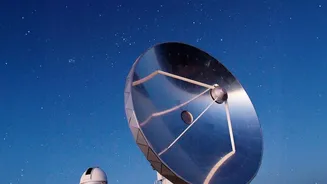
Planetary defense begins with detection. A sophisticated, NASA-funded network of robotic telescopes acts as our planet's early warning system. Key players in this effort include the Asteroid Terrestrial-impact Last Alert System (ATLAS), the Pan-STARRS observatory, and the Catalina Sky Survey. ATLAS, for instance, consists of telescopes in Hawaii, Chile, and South Africa, which together can scan the entire dark sky every 24 hours. This global placement ensures that no part of the sky is left unobserved, regardless of the time of day. These surveys are designed to find moving objects against the fixed backdrop of stars. They take multiple pictures of the same patch of sky minutes apart; any 'star' that has moved is flagged for further investigation.
From Detection to Prediction
Spotting a moving dot is just the beginning. Once a potential NEO is detected, the data is sent to the Minor Planet Center, a global clearinghouse for all such observations. From there, astronomers worldwide, including those at NASA's Center for Near-Earth Object Studies (CNEOS), perform follow-up observations. Each new data point helps them refine the object's orbit with incredible precision. They can then project its path years or even decades into the future to determine if it poses any threat to Earth. An object is labelled a 'Potentially Hazardous Asteroid' if its orbit brings it within 7.5 million kilometres of Earth's orbit and it's larger than about 140 meters across. This designation doesn't mean it will hit us, but that it warrants close and continuous monitoring.
A Shield in the Making
Tracking is crucial, but it's only half the story. The ultimate goal is protection. The information gathered by these telescope networks is fed into NASA's Planetary Defense Coordination Office (PDCO). This office is responsible for not only issuing warnings but also for studying and developing mitigation strategies. The most dramatic example of this was the Double Asteroid Redirection Test (DART) mission, which successfully altered the orbit of a small asteroid by crashing a spacecraft into it. This proved that a 'kinetic impactor' is a viable method for deflecting a dangerous asteroid, provided we have enough warning time. And that warning time—years or even decades—is precisely what the telescope networks are designed to provide. Warning gives us options, allowing us to prepare and, if needed, act.
The Future of Planetary Defense
The system is constantly improving. While current ground-based telescopes are incredibly effective, they have limitations. They can only observe at night and can struggle to spot asteroids that approach from the direction of the Sun. To close this gap, NASA is developing the NEO Surveyor, an infrared space telescope scheduled for launch around 2027. Operating from space, it will be able to detect asteroids that are difficult for ground systems to see. NEO Surveyor is expected to dramatically accelerate the discovery rate, helping scientists meet the goal of finding 90 percent of all potentially hazardous NEOs larger than 140 meters. This represents a move from a collection of surveys to a purpose-built, coordinated planetary protection system.