



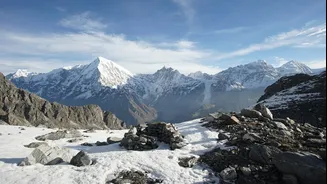
The Undisputed Star: Kedarkantha
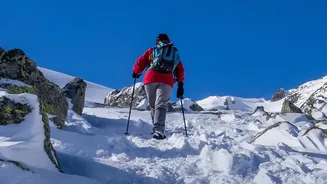
Often called the 'Queen of Winter Treks', Kedarkantha’s popularity is well-earned. Located in Uttarakhand’s Govind Wildlife Sanctuary, it’s the quintessential snow trek that many beginners cut their teeth on. Its appeal lies in a perfect formula: accessible
for beginners, a manageable duration of 5-6 days, and the thrill of reaching a proper summit at 12,500 feet. The trail is a journey through fairytale-like pine forests, clearings with stunning campsites, and the frozen Juda-ka-Talab lake. The final push to the summit starts pre-dawn, rewarding trekkers with a breathtaking 360-degree panorama of Himalayan giants like the Swargarohini and Bandarpoonch ranges. While its popularity means trails can be crowded, especially during peak season, its role as a perfect introduction to Himalayan winter trekking remains unmatched.
The Challenger: Brahmatal Trek
For those seeking a quieter trail with a different flavour, the Brahmatal trek is a stellar alternative. Also in Uttarakhand, this trek is less about a single summit push and more about the journey itself, which includes ridge walks with constant, dramatic views of Mt. Trishul and Nanda Ghunti. The highlights are its two high-altitude lakes, Bekaltal and Brahmatal, which often freeze over in peak winter, creating a mystical landscape. Graded as easy-to-moderate, Brahmatal is often compared to Kedarkantha. It’s slightly longer, typically 6 days, but some find its ascents more gradual, even if the total distance covered is greater. If your priority is seeing frozen alpine lakes and enjoying expansive ridge views with fewer people, Brahmatal is an excellent choice.
The Meadow of Dreams: Dayara Bugyal
If your vision of a winter trek involves vast, undulating meadows blanketed in pristine snow, Dayara Bugyal is your destination. Often cited as one of the most beautiful alpine meadows in India, this trek offers a different kind of grandeur. Considered one of the best treks for absolute beginners and families, the ascent is gentle and the landscape is wide open. The trail winds through oak forests before revealing the enormous snowfields. From the highest point, around 12,000 feet, you get magnificent views of the Gangotri ranges and peaks like Bandarpoonch. In the 2026-27 season, it stands out as a top recommendation for those who want the snow experience without the summit pressure of Kedarkantha, offering tranquility and stunning photo opportunities.
The Pilgrim’s Peak: Chopta-Chandrashila
Combining spiritual heritage with some of the most awe-inspiring mountain views, the Chopta-Chandrashila trek is a compact and powerful winter journey. The route takes you to Tungnath, the highest Shiva temple in the world, which sits serenely amidst the snow. From there, a further climb leads to the Chandrashila summit at just under 13,000 feet. The reward is an astounding 270-degree panorama of the Garhwal and Kumaon Himalayas, including major peaks like Nanda Devi, Trishul, and Chaukhamba. Though the Tungnath temple itself is closed in peak winter, the trail remains a popular and accessible adventure. For trekkers short on time but hungry for big mountain scenery and a touch of culture, this trek is a fantastic option.
The Historic Route: Kuari Pass
For those with a bit more trekking experience or a higher level of fitness, the Kuari Pass trek, also known as the Lord Curzon Trail, offers a grander scale of adventure. While still graded easy-to-moderate, it feels like a bigger expedition. Its main draw is the unmatched panorama of peaks visible from the pass, including India’s second-highest peak, Nanda Devi, as well as Kamet and Dronagiri. The trail itself is a journey through ancient forests, charming villages, and expansive meadows (bugyals) like Gorson. Typically a 6-day trek, it offers a dual-season experience but transforms into a classic snow adventure from December to April. If you want a trek steeped in history with some of the most epic mountain views, Kuari Pass delivers.