


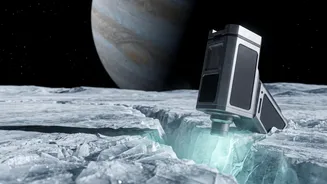

A Moon with a Secret
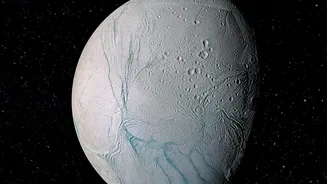
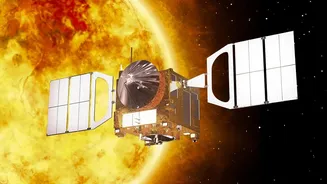
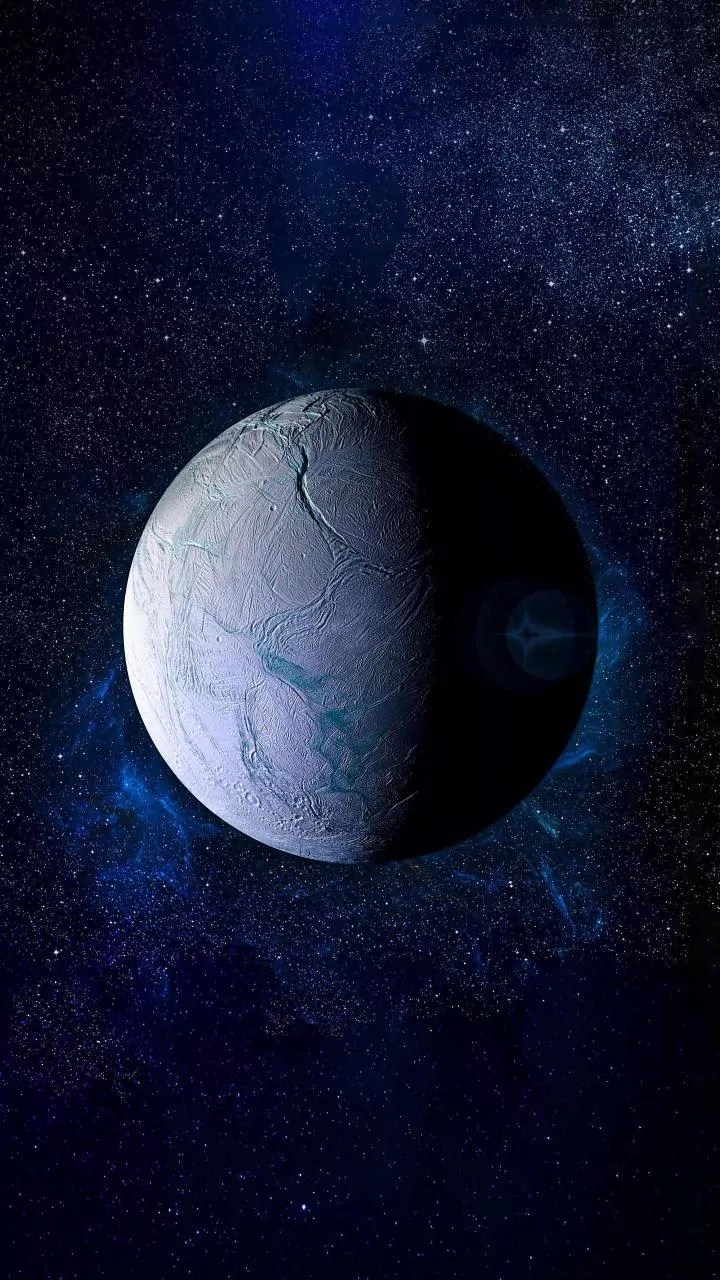
Enceladus is one of the most reflective bodies in our solar system, covered in clean, white ice. For a long time, it was just another dot in the sky. But in 2005, NASA's Cassini spacecraft flew by and discovered something extraordinary: giant geysers,
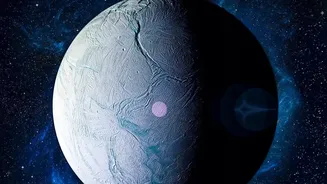
or plumes, erupting from cracks near its south pole. These plumes spew ice particles, water vapor, and other gases hundreds of miles into space at incredible speeds. This discovery was a game-changer. It pointed to the existence of a liquid ocean hidden beneath the moon's icy shell. Further data confirmed it: Enceladus hides a global, saltwater ocean, kept liquid by heat generated from Saturn's gravitational pull. Suddenly, this tiny moon became one of the most compelling places to look for life beyond Earth.
Tasting the Plumes
The beauty of the plumes is that they offer a free sample of the ocean below. A probe doesn't need to drill through miles of ice; it can simply fly through the spray. This is exactly what the Cassini spacecraft did. To analyze the plume's contents, Cassini used instruments that acted like a cosmic sense of smell and taste. The two key players were the Ion and Neutral Mass Spectrometer (INMS) and the Cosmic Dust Analyzer (CDA). The INMS 'sniffed' the gas, while the CDA 'tasted' the solid ice grains. When an ice particle hit the CDA's detector at high speed, it vaporized instantly. The instrument then analyzed the resulting cloud of atoms and molecules to determine its chemical makeup. This process, called mass spectrometry, allowed scientists to identify the ingredients of Enceladus's hidden sea from millions of miles away.
The Ingredients for Life
What Cassini found was tantalizing. The plumes contain not just water, but a rich cocktail of chemicals. Scientists have confirmed the presence of carbon dioxide, methane, ammonia, and various organic compounds. They also detected molecular hydrogen, a key finding because on Earth, some microbes use hydrogen as a food source. This, combined with evidence of hydrothermal vents on Enceladus's seafloor, paints a picture of an environment eerily similar to deep-sea ecosystems on our own planet. More recent analysis of the Cassini data has even found hydrogen cyanide, a versatile molecule considered a key precursor for forming amino acids, the building blocks of proteins. In 2023, scientists announced the detection of phosphorus, the final of the six essential elements for life (CHNOPS), in the plume material. Enceladus appears to have all the necessary ingredients: liquid water, chemical building blocks, and an energy source.
Searching for Biosignatures
Finding ingredients for life isn't the same as finding life itself. The next step is to look for biosignatures—substances or patterns that provide evidence of life. These could be complex organic molecules like lipids (fatty acids) or specific ratios of amino acids. Life, as we know it, uses a specific set of amino acids and prefers them in a particular orientation (a property called chirality). Finding such a pattern on Enceladus would be a powerful, though not definitive, sign of biology. However, Cassini's instruments were designed in the 1990s and weren't built to detect these specific, complex signs of life. The challenge for scientists is distinguishing a signal produced by a living organism from one created by non-biological geochemistry. For instance, the methane found could be produced by microbes (methanogenesis) or by geological processes.
The Next Generation of Life-Finders
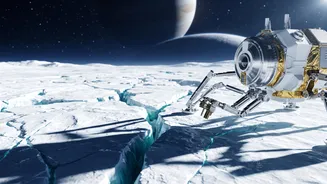
The discoveries at Enceladus have spurred a new wave of mission concepts designed specifically to search for life. Scientists are proposing advanced orbiters with next-generation mass spectrometers that are far more sensitive than Cassini's. A proposed mission concept like the Enceladus Orbilander would first orbit the moon to analyze the plumes in detail, then land on the surface to examine the material that has fallen back as 'snow'. These future probes would be equipped to detect complex biosignatures like lipids and amino acids with high precision. The goal is to capture plume particles at lower velocities to preserve any complex organic molecules, or even whole cells, that might be inside. By making multiple passes through the densest parts of the plume, these missions could collect enough material to finally answer the question of whether we are alone in our solar system.