



Beyond the Goldilocks Zone
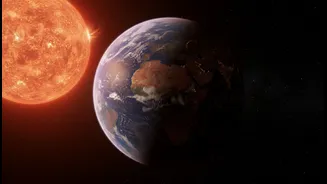
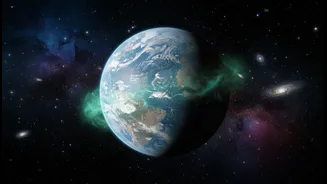
For decades, the search for life has focused on the “habitable zone,” often called the “Goldilocks zone.” This is the orbital range around a star where temperatures are just right—not too hot, not too cold—for liquid water to exist on a planet’s surface.
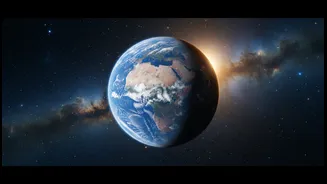
Finding a rocky planet in this region is a crucial first filter for astronomers. However, scientists are clear that this is only a starting point. A planet’s location doesn't guarantee a welcoming environment. As we see in our own solar system, Mars is within the habitable zone but is a cold, barren desert, while Venus, just on the inner edge, has a crushingly hot and toxic atmosphere. This proves that distance alone isn't enough to make a world liveable.
An Atmosphere's Vital Role
A planet's atmosphere is the true gatekeeper of habitability. This gaseous blanket does far more than just provide air to breathe. It regulates temperature through the greenhouse effect, shielding the surface from extreme heat and cold. Without our atmosphere, Earth’s average temperature would plummet far below freezing. An atmosphere also provides protection from a star's harsh radiation and can create the necessary surface pressure to keep water in a stable liquid state. Therefore, before we can make any grand claims about a distant world, we need to know if it even has an atmosphere and, if so, what it's made of. Its composition determines whether a planet is a paradise or a poisoned wasteland.
Searching for Cosmic Fingerprints
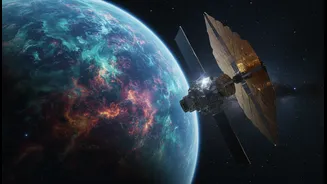
To check for habitability, scientists use powerful tools like the James Webb Space Telescope (JWST) to perform what is called transit spectroscopy. As a planet passes in front of its star, starlight filters through its atmosphere. By analysing the spectrum of that light, astronomers can detect the chemical fingerprints of different gases. They are looking for “biosignatures”—gases that could indicate the presence of life. On Earth, the most prominent biosignatures include oxygen, methane, and carbon dioxide. The presence of certain combinations of these gases, especially those that shouldn't exist together without a constant source replenishing them, could point to biological activity.
The Challenge of False Positives
The detection of a gas like oxygen would be a monumental discovery, but it wouldn't automatically mean we've found alien life. A major challenge in this field is ruling out “false positives.” Many gases we associate with life can also be produced by non-biological, or abiotic, processes. For instance, intense ultraviolet radiation from a star can split carbon dioxide molecules, releasing oxygen into the atmosphere without any living organisms involved. Geologic activity or specific photochemical reactions can also generate methane. Scientists must therefore look at the full context, searching for other chemical clues that might reveal a non-biological origin for these gases. The goal is to find a signal that can only be convincingly explained by life.
Patience in the Grand Search
The work being done by observatories like the JWST is revolutionizing our ability to peek into the skies of distant worlds. Recent observations have successfully identified molecules like water vapour, carbon dioxide, and even sulfur dioxide in the atmospheres of various exoplanets, providing incredible insights into their climate and chemistry. However, these are often large, gaseous planets not considered candidates for life. Probing the thin atmospheres of smaller, rocky planets in the habitable zone is far more difficult and will require extensive, patient observation. Scientists stress that confirming a true biosignature will be a slow, methodical process of gathering evidence and painstakingly ruling out every other possible explanation. Each discovery is a step forward, but definitive answers are likely still a long way off.