


Why August Is a Great Month for Saturn
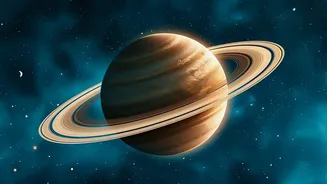
Throughout August 2026, Saturn will become progressively easier to see. Early in the month, it rises later in the evening, but by the end of August, you'll be able to spot it from around 9 PM local time, rising in the eastern sky. This period is the build-up
to the planet's opposition on October 4, 2026. Opposition is the point in a planet's orbit when Earth passes directly between it and the Sun. An outer planet is at its closest and brightest for the year around opposition, making it the ideal time for observation. So, while October is the peak, August provides an excellent and increasingly convenient window to start your Saturn-gazing journey. The planet will be visible all night, tracking across the sky from east to west.
Finding the Ringed Planet
You don't need to be an expert to find Saturn. This month, it will be located in the constellation Pisces. To the naked eye, it will appear as a bright, steady, yellowish-white point of light, shining at a magnitude of around 0.5. Unlike stars that twinkle due to atmospheric disturbance, planets typically shine with a more constant light. Saturn will be noticeably brighter than the stars in its immediate vicinity. On the nights of August 30 and 31, the Moon will pass close to Saturn, making it exceptionally easy to identify the planet in the night sky. Several smartphone apps can also help you pinpoint its exact location from your city.
What to Expect: From Naked Eye to Telescope
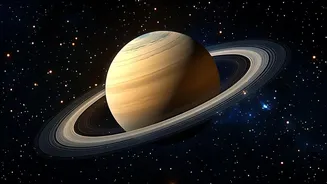
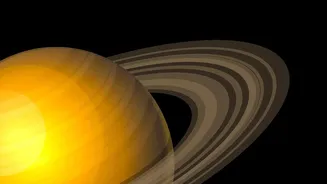
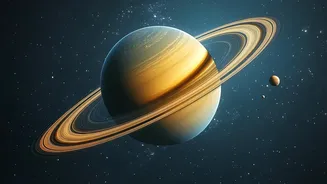
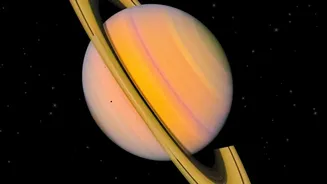
Your viewing experience will depend on your equipment. With just your eyes, Saturn is an impressive, bright 'star'. A good pair of binoculars mounted on a tripod might reveal that the point of light is not perfectly round, but slightly oval—a tiny hint of the rings you're looking for. However, to truly see the rings, you'll need a telescope. Even a basic telescope with a 60mm or 75mm aperture at 50x magnification is usually enough to resolve the rings as distinct from the planet itself. This year, the view is particularly interesting. After being edge-on and virtually invisible in 2025, the rings are now tilting back towards us. In August 2026, the tilt will be around 9 degrees, appearing as a thin but definite slash of light.
A Fleeting View of the Rings
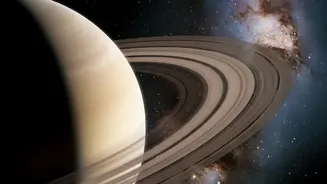
This year's viewing has an added layer of astronomical drama. In March 2025, Saturn's rings were oriented edge-on to Earth, a phenomenon called a 'ring plane crossing' that happens every 13 to 15 years. Because the rings are incredibly thin—only about 10 metres thick in most places—they seem to disappear from our perspective. We are now on the other side of that event, and the rings are slowly opening back up to our view. By 2032, they will be tilted at their maximum angle, offering the most spectacular views. Viewing them now, in their slender presentation, is a chance to appreciate the delicate and ever-changing geometry of our solar system. It’s a reminder that this view is not static. In fact, scientists believe that due to 'ring rain' pulled in by Saturn's gravity, the rings will eventually disappear entirely, though likely not for another 100 million years or so.
Tips for the Best Viewing Experience
To make the most of your Saturn-gazing session, find a location away from bright city lights. Light pollution washes out fainter objects in the sky. Let your eyes adapt to the darkness for about 15-20 minutes. While Saturn itself is bright, a dark-adapted eye will have a much better chance of appreciating the details through a telescope. Patience is key when using a telescope; wait for moments of still air for the sharpest image. The planet will be highest in the sky and best for viewing after midnight. Whether you're just stepping out to spot a bright planet or setting up a telescope for a closer look, this August is a perfect time to connect with one of the true wonders of our solar system.