


A Cosmic Shadow Play
The primary technique for this cosmic detective work begins with an event called a 'transit'. This happens when a planet, from our point of view, passes directly in front of its star. As it does, it blocks a tiny fraction of the starlight, causing a minuscule
dip in the star's brightness. Powerful telescopes can detect this dimming, which not only confirms the planet's existence but also tells us its size and how long its year is. But the most fascinating part happens at the edges of the planet's shadow, where a sliver of starlight shines through its atmosphere.
Decoding a Barcode of Light
That thin halo of starlight is where the magic lies. As the light passes through the exoplanet's atmosphere, gases and chemicals present in that atmosphere absorb very specific colours, or wavelengths, of the light. Each gas has a unique absorption signature, like a chemical fingerprint. When astronomers collect the remaining starlight, they can analyze its spectrum. The missing colours in that spectrum create a unique pattern, much like a barcode. By reading this 'barcode', scientists can determine exactly which gases are present in the planet's atmosphere.
Chemical Clues from Afar
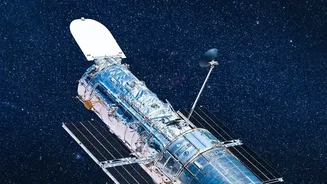
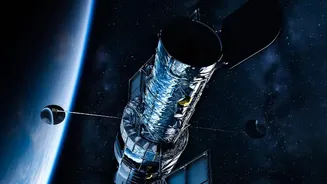
This method, known as transmission spectroscopy, is incredibly powerful. It allows us to build a picture of worlds we will never touch. For instance, astronomers using the James Webb Space Telescope (JWST) have successfully identified a range of molecules in the atmospheres of distant exoplanets. They have confirmed the presence of water vapour, carbon dioxide, methane, and even sulfur dioxide. Finding these chemicals helps scientists understand a planet's climate, composition, and whether it might have the basic ingredients necessary to support life as we know it.
The Search for Biosignatures
The ultimate goal for many in this field is to find a 'biosignature' — a combination of gases that strongly suggests the presence of life. On Earth, for example, the large amount of oxygen in our atmosphere is constantly replenished by plants and microbial life. Finding a similar mix of gases, such as oxygen and methane together, on a rocky, Earth-sized planet could be a monumental discovery. It wouldn't be definitive proof of aliens, as non-biological processes can sometimes mimic these signs, but it would be the most compelling hint yet that we are not alone in the universe. This is the holy grail of exoplanet science.
A New Era of Discovery
For decades, this type of analysis was limited by technology. But with the advent of next-generation observatories like the James Webb Space Telescope, we have entered a golden age of atmospheric characterization. JWST's incredible sensitivity allows it to capture starlight with unprecedented clarity, revealing fainter and more complex atmospheric details than ever before. It is already transforming our understanding of planetary systems and moving us closer to answering the profound question of habitability beyond Earth. Future missions, like the planned Habitable Worlds Observatory, will be designed specifically to build on this work.