


What Is This ‘New’ Star?
First, let's clarify: we aren't getting a brand-new star. What we are getting is arguably even cooler. The event involves a star system called T Coronae Borealis (T CrB), located about 3,000 light-years away. Normally, it’s far too dim to see without
a powerful telescope. But soon, it's expected to undergo a massive eruption known as a nova, causing it to brighten dramatically. For a few days, it will become as bright as Polaris, the North Star, and will be visible to the naked eye as a 'new' point of light in the heavens before it fades back into obscurity. Think of it less as a star being born and more as a quiet celestial neighbour suddenly throwing a very loud, very bright party.
The Cosmic Dance of Two Stars
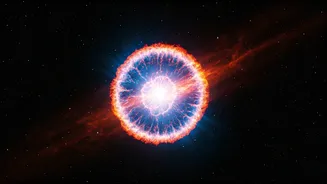
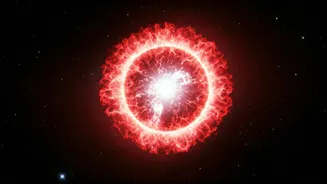
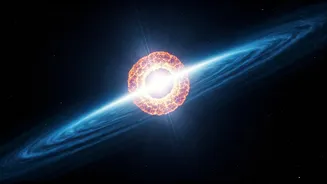
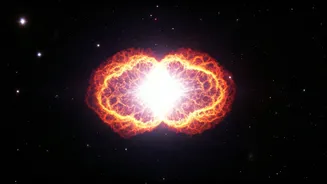
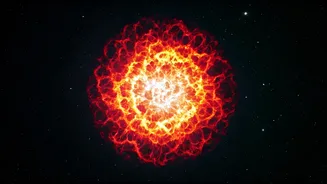
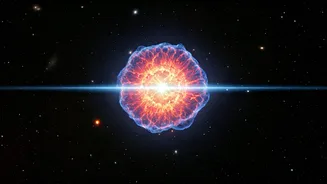
So, what causes this spectacular outburst? T Coronae Borealis isn't a single star but a binary pair locked in a gravitational dance. The system consists of a red giant—a large, ageing star—and a white dwarf, which is the incredibly dense, hot core of a star that has exhausted its nuclear fuel. The white dwarf’s powerful gravity is constantly pulling material, mostly hydrogen, from its larger companion. This material piles up on the white dwarf's surface, forming a dense, hot layer. Over time, the pressure and temperature in this layer build to a critical point. When it reaches about 10 million degrees Celsius, it triggers a runaway thermonuclear explosion. This is the 'detonation'—a cataclysmic blast that violently ejects the accumulated material into space and produces a brilliant flash of light we see as the nova.
How and When to See It
This is the exciting part. The nova is predicted to occur sometime between now and September 2024. Unfortunately, astronomers can't give an exact date, so the key is to be ready. The 'new' star will appear in the constellation Corona Borealis, or the 'Northern Crown,' a small, semi-circular arc of stars located between the constellations of Hercules and Boötes. For viewers in India and the rest of the Northern Hemisphere, this constellation is well-placed for viewing in the evenings. When the nova erupts, you won't need a telescope or binoculars. Just find a dark spot away from city lights, look up, and you should be able to spot the temporary guest in the Northern Crown. It will likely remain visible to the naked eye for several days and with binoculars for about a week.
A Once-in-a-Lifetime Recurring Event
One of the most fascinating things about T CrB is that it's a 'recurrent nova.' The explosion doesn't destroy the white dwarf, which allows the whole process to start over. This cycle repeats roughly every 80 years. The last time T CrB flared up was in 1946, and before that, in 1866. This means that witnessing this event isn't just about seeing a cosmic explosion; it's about connecting with a moment that our grandparents or great-grandparents may have experienced. Each eruption offers scientists a chance to study the physics of novae with increasingly advanced technology. For the rest of us, it's a rare opportunity to see a celestial event that follows a human-scale timeline, linking generations of stargazers.
Nova, Not Supernova
It’s important to distinguish this event from a supernova. A supernova is a far more violent explosion that marks the complete and utter death of a star. It happens when a massive star runs out of fuel and its core collapses, or when a white dwarf accretes so much matter that it triggers a star-destroying chain reaction. A supernova completely obliterates the star and only happens once. A nova, like the one from T CrB, is a surface-level event. The underlying white dwarf survives the blast and can continue to accumulate matter for future eruptions. So while the T CrB event will be spectacular, it's a renewable spectacle, not a final farewell.