





The Core Question: Rotation vs. Stabilization
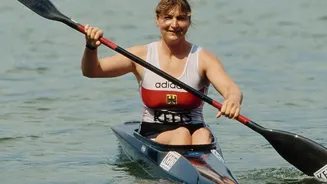
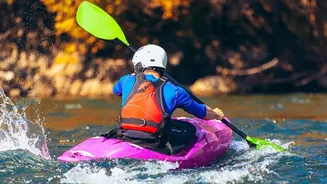
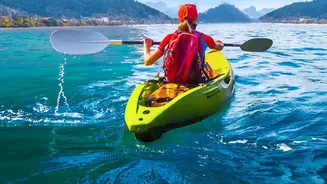
Both sports are celebrated for their core-strengthening benefits, but they engage your midsection differently. In kayaking, the primary movement involves twisting your torso to pull the paddle through the water. This develops powerful rotational strength,
heavily recruiting your obliques and abdominal muscles with every stroke. Think of it as a dynamic, twisting exercise that builds power for explosive movements. Stand-up paddleboarding, on the other hand, is all about stability. Your core is constantly working to keep you balanced on an unstable surface. This targets the deep transverse abdominal muscles and lower back, building endurance and control. While you also rotate to paddle, the main challenge for your core is maintaining balance, which makes it a non-stop stability workout.
Upper Body Focus: The Kayaker's Advantage
If your primary goal is building upper body and back strength, kayaking has a clear edge. The paddling motion is a powerful pulling exercise that directly targets the latissimus dorsi ('lats'), the large muscles in your back. With every stroke, you also engage your shoulders (deltoids), biceps, and triceps. Over time, the repetitive nature of paddling builds significant muscle endurance and strength in the arms, chest, and entire back. While paddleboarding does work the upper body, the movement is less focused on a powerful pull and more integrated with the core and lower body.
Total Body Workout: The Paddleboarder's Domain
Stand-up paddleboarding is often described as a true full-body workout, and for good reason. From the moment you stand on the board, your body is working from head to toe. Your feet and ankles are constantly making micro-adjustments to maintain balance, engaging stabilizer muscles. Your legs, including your quads, hamstrings, and glutes, remain in a slight squat position, providing a continuous isometric workout. While your upper back, shoulders, and arms are involved in the paddling stroke, their effort is part of a kinetic chain that starts at your core and extends through your entire body. This makes SUP an excellent choice for integrated, functional strength and overall muscle toning.
Cardiovascular and Low-Impact Benefits
Beyond pure strength, both activities provide excellent low-impact cardiovascular workouts. This makes them ideal for individuals who want to improve heart health without putting stress on their joints. You can easily vary the intensity of either sport. A leisurely paddle on calm water is a relaxing, light-intensity exercise, while paddling against wind, in choppy water, or at a faster pace can elevate your heart rate significantly, burning hundreds of calories per hour. Because both sports are low-impact, they are accessible to a wide range of fitness levels, from beginners to seasoned athletes.
Making Your Choice: Power or Balance?
So, which sport is right for your strength goals? The decision comes down to what you want to achieve. If your main objective is to build a powerful back and strong, defined arms and shoulders through a focused upper-body workout, kayaking is your best bet. The seated position isolates the upper body and core for rotational power. If you are looking for a more holistic, full-body workout that enhances balance, core stability, and functional strength from your feet to your shoulders, then stand-up paddleboarding is the superior choice. It trains your muscles to work together as a single, coordinated unit.