



A New King in the Solar System
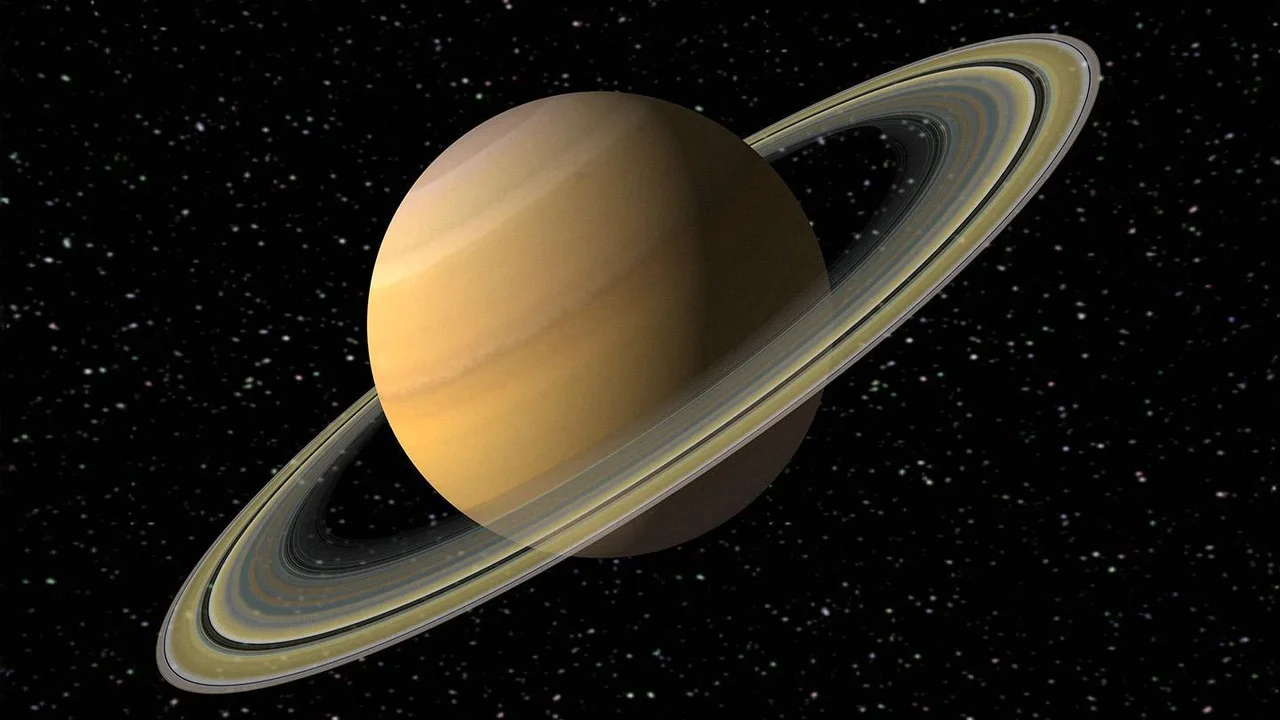
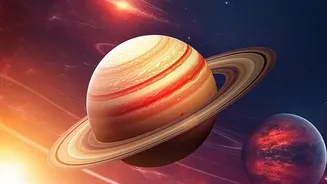
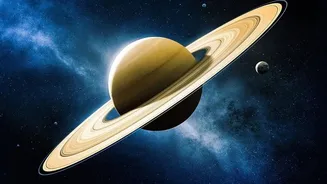
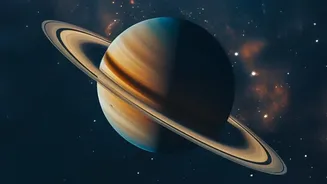
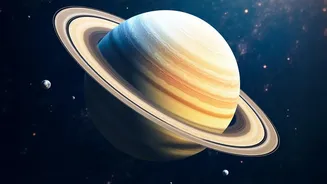
For decades, Jupiter held the title of ‘moon king’. But thanks to a series of massive discoveries, Saturn has decisively claimed the crown. As of mid-2026, the official count of confirmed moons orbiting the ringed planet stands at a staggering 293. This
number didn't just creep up; it leaped forward in huge bursts. In May 2023, the count jumped from 83 to 145. Then, in March 2025, an astonishing 128 more moons were announced at once. Subsequent discoveries in 2026 pushed the total even higher, solidifying Saturn's lead. Most of these newfound satellites are not giant spheres like our own Moon or Saturn's famous Titan. Instead, they are small, irregular bodies, some only a few kilometres across, orbiting far from the planet.
The Art of Moon Hunting
Finding these faint, remote objects is a monumental task. Astronomers use powerful ground-based telescopes, like the Canada-France-Hawaii Telescope and the Subaru Telescope in Hawaii, to conduct deep surveys of the sky around Saturn. The breakthrough technique is often called “shift and stack.” Scientists take a series of images over several hours and digitally shift them at the predicted speed of a potential moon. When the images are layered, or stacked, the faint signal of the moving moon is amplified, allowing it to become visible against the background noise of stars. It's like a digital long-exposure photograph, but one that follows a moving target. An international team led by Dr. Edward Ashton has used this method to uncover hundreds of Saturn's moons in recent years.
From Candidate to Confirmed Moon
Spotting a faint dot moving near Saturn is just the beginning of the journey. To be officially recognized, a celestial body must be proven to be a natural satellite, meaning it is gravitationally bound to the planet. This requires years of follow-up observations to track the object's path and calculate a stable orbit. All discoveries are reported to the International Astronomical Union's (IAU) Minor Planet Center, which acts as the official clearinghouse for these findings. Once the orbit is confirmed, the moon is given a provisional designation, such as S/2023 S 1 (the first satellite of Saturn discovered in 2023). Only after this rigorous process is it added to the official census.
So, What Exactly Is a Moon?
Surprisingly, the IAU, which famously defined what a 'planet' is, does not have a formal, scientific definition for a 'moon'. The general working definition is a natural object that orbits a planet or dwarf planet. There is no official minimum size. This is why Saturn's count can be so high; a chunk of rock a few kilometres wide counts just as much as the colossal moon Titan, which is larger than the planet Mercury. These newly found objects are distinct from the countless smaller 'moonlets' that make up Saturn's famous rings. While those particles also orbit the planet, the confirmed moons are individual bodies with their own stable, traceable orbits outside the main ring system.
Why This Cosmic Census Matters
This explosion in the number of known moons is more than just a numbers game. Most of the new discoveries are 'irregular' moons. They have large, tilted, and often backward (retrograde) orbits, suggesting they weren't formed with Saturn but were instead captured by its immense gravity long ago. These moons are like cosmic fossils, offering clues about the chaotic environment of the early solar system. By studying their orbital families, scientists can piece together the history of ancient collisions that shattered larger parent moons into the fragments we are discovering today. Each new moon is another piece of the puzzle, helping us understand how our planetary neighbourhood came to be.