




India’s Next Giant Leap in Space
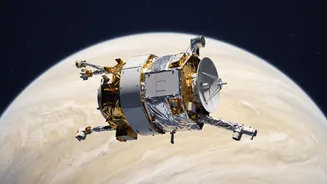
Following the historic successes of its Chandrayaan missions to the Moon and the Mangalyaan mission to Mars, ISRO is setting its sights on the second planet from the Sun. The Shukrayaan mission, officially the Venus Orbiter Mission, represents India's
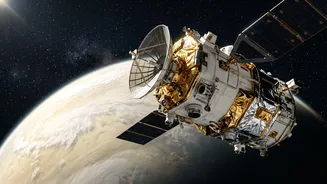
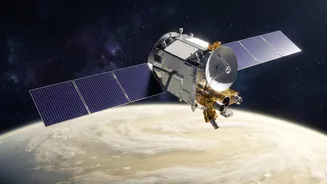
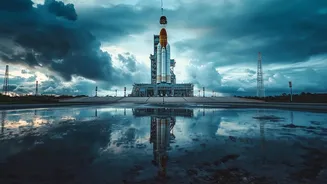
first foray to our closest planetary neighbour. Formally approved by the Union Cabinet in September 2024, the mission is currently scheduled for a March 2028 launch aboard the powerful LVM-3 rocket. After a journey of about 112 days, the orbiter is expected to enter a large elliptical orbit around Venus in July 2028. From there, it will perform a series of aerobraking manoeuvres, using the planet's own atmosphere to gradually lower its orbit to a more suitable altitude for scientific observation, planned to be around 200 x 600 kilometres. The mission is designed to operate for four years, gathering invaluable data on a world that, despite its proximity, remains deeply enigmatic.
Sensors Built for a Hostile World
The headline update for the Shukrayaan mission revolves around its sophisticated suite of scientific instruments, or payloads, which will weigh approximately 100 kilograms in total. A key focus of the mission is to analyze the dense, toxic atmosphere of Venus. To achieve this, the orbiter will carry a range of specialized sensors. Among the international contributions is the Venus InfraRed Atmospheric Gases Linker (VIRAL), an instrument co-developed with Russia and France, designed specifically to study the chemical composition of the atmosphere. This and other spectrometers will measure the makeup of the thick clouds of sulfuric acid and hunt for clues about the planet's weather patterns and the processes that drive them. Another payload, a collaboration between ISRO and Sweden, is the Venusian Neutrals Analyzer (VNA), which will study how the solar wind interacts with the upper atmosphere. This is particularly important because Venus lacks a strong magnetic field to protect it, meaning the solar wind directly strips particles away from the planet.
Unlocking the Secrets of a Runaway Greenhouse
But why is studying Venus’s atmosphere so important? Scientists believe that Venus and Earth started out as similar rocky planets, and Venus may have once hosted liquid water. Today, however, it is the hottest planet in the solar system, with surface temperatures reaching 465 degrees Celsius—hot enough to melt lead. This is the result of a runaway greenhouse effect, where a thick atmosphere, composed of over 96% carbon dioxide, traps heat. By studying this extreme environment, scientists hope to gain crucial insights into how planetary climates evolve. The data from Shukrayaan will help refine climate models, not only for understanding Venus but also for predicting long-term climate scenarios here on Earth. The mission also aims to investigate Venus's geology, using a high-resolution Synthetic Aperture Radar (SAR) to peer through the dense clouds and map the surface in unprecedented detail, searching for signs of active volcanoes.
India’s Place in a Renewed Race to Venus
ISRO is not alone in its renewed interest in Venus. NASA has two missions planned—VERITAS and DAVINCI+—and the European Space Agency is preparing its EnVision orbiter. The launch of Shukrayaan will solidify India's position as a key player in global planetary science. The mission follows ISRO’s successful model of combining indigenously developed instruments with international collaborations, bringing in expertise from Sweden, Russia, Germany, and France. This collaborative approach not only enhances the scientific capabilities of the mission but also strengthens diplomatic ties and India's role as a trusted partner in space exploration. With a total project cost of approximately ₹1,236 crore, the mission is also a testament to ISRO's ability to conduct cost-effective interplanetary exploration.