



How Rockets Traditionally Land
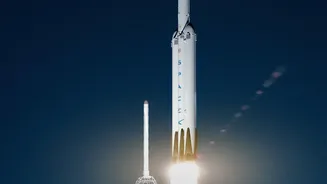
For years, the gold standard for reusable rockets was set by SpaceX's own Falcon 9. After launching its payload, the first-stage booster performs a series of engine burns to guide itself back to Earth, deploying landing legs just moments before touching
down either on a ground pad or a drone ship at sea. This method was revolutionary, proving that rockets could be recovered and reflown. However, it isn't perfect. The landing legs add significant weight that has to be launched into the sky on every flight, reducing the rocket's efficiency and the amount of cargo it can carry. Furthermore, after landing at sea, the booster must be transported back to land, secured, inspected, and then moved to a launch pad for its next mission—a time-consuming logistical process.
The Tower-Catch: A Radical New Approach
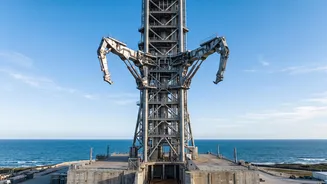
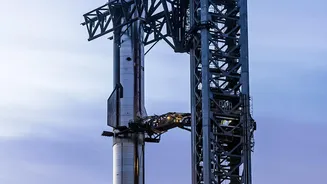
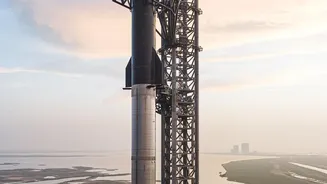
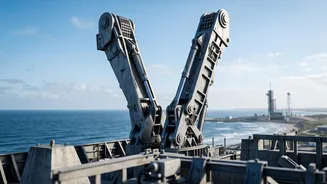
With Starship's Super Heavy booster, SpaceX is throwing out the old playbook. Instead of landing legs, the booster has small, reinforced 'hardpoints' near its top. The plan involves the booster flying back to the launch site, hovering just beside the launch tower, and allowing a pair of huge mechanical arms—nicknamed 'Mechazilla'—to close around it and lift it clear. These arms, part of the launch tower itself, are designed to absorb the immense momentum of the returning booster and place it directly back onto the launch mount. This integrated system turns the launch tower from a passive support structure into an active part of the recovery process. The maneuver requires incredible precision, with the booster, tower, arms, engines, and guidance systems all working together flawlessly.
The Primary Benefit: Mass Efficiency
The main reason for this complex manoeuvre is simple: weight. Landing legs strong enough to support the colossal Super Heavy booster would need to be massive, adding dead weight that serves no purpose for 99% of the flight. By moving the landing hardware from the rocket to the ground, where weight is not a concern, the booster becomes lighter and more efficient. According to the engineering philosophy of 'nothing left to take away', removing the legs is a huge step toward perfection. This mass saving directly translates into a greater payload capacity, meaning Starship can carry more cargo, fuel, or crew on each mission, improving the economics of every launch.
The Goal: Rapid, Airline-Style Operations
Catching the booster and placing it directly back onto the launch mount eliminates several major logistical steps. There's no need for a sea voyage, no complex transport on land, and no separate crane to lift the booster onto the pad. This dramatically simplifies and shortens the turnaround time between launches. SpaceX's ultimate goal is to achieve airline-like operations, with the potential for the same booster to be launched multiple times in a single day. This high launch cadence is essential for the company's ambitions, such as deploying its next-generation Starlink satellite network and executing the multiple orbital refueling flights needed for missions to the Moon and Mars.
A High-Risk, High-Reward Gamble
The tower-catch strategy is not without significant risks. The precision required is immense; a slight miscalculation could result in the booster colliding with the tower, potentially destroying both the vehicle and the costly launch infrastructure. Unlike a leg-based landing where there's a wider margin for error, the tower catch is a binary outcome—it either works perfectly, or it fails catastrophically. Early test flights have focused on perfecting the booster's return and hover capabilities, slowly building confidence before attempting the catch. Despite the risks, SpaceX has calculated that the reward—achieving a fully and rapidly reusable launch system—is worth the engineering challenge.