


Beyond the Daytime Crowds
Visiting a fort at night is an entirely different experience. The usual chatter and footsteps are replaced by a profound silence, broken only by the wind whistling through ancient archways. It’s an opportunity to connect with history on a more personal
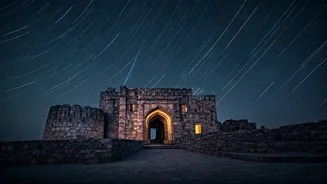
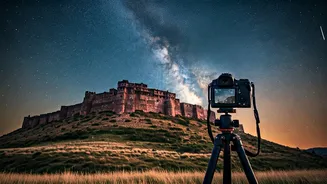
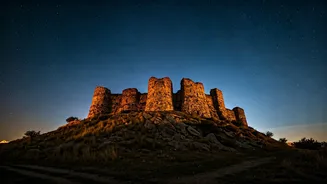
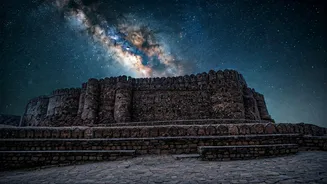
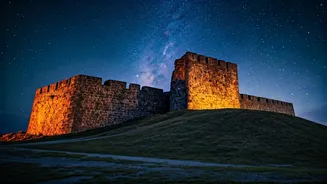
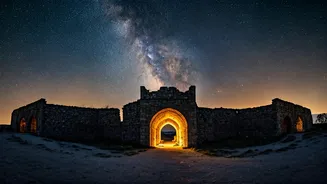
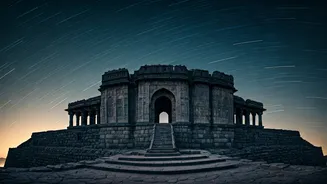
level, imagining the centuries of drama that unfolded within these walls. For a photographer, the appeal is twofold. First, there's the challenge and reward of astrophotography—capturing the fort's silhouette against a blanket of stars or the Milky Way. Second, it’s a chance to play with light. Using techniques like light painting, you can selectively illuminate crumbling ramparts, mysterious gateways, and lonely watchtowers, creating images that are dramatic, eerie, and impossible to capture in daylight.
Choosing Your Moonlit Bastion
Not all forts are suitable for a midnight expedition. The ideal candidate is one that is legally accessible, relatively safe to navigate in the dark, and popular for night treks. Research is key. Start with forts that are well-documented and have known trails. Many forts in Maharashtra, like Lohagad, Visapur, or Rajgad near Pune, are popular destinations for organised night treks. Their paths are trodden and you’re likely to find groups there. In Rajasthan, forts like Nahargarh, which overlooks Jaipur, offer stunning city light backdrops, and parts of it are accessible. Before you go, check local regulations. Some forts are protected archaeological sites and may be closed to the public after sunset. Always prioritise forts where night access is either permitted or a common, accepted practice for trekkers.
Gearing Up for the Dark
Night photography demands more than just your phone camera. To do it justice, you’ll need some specific gear. A DSLR or mirrorless camera with manual mode is essential. A sturdy tripod is non-negotiable; you'll be using long exposures, and any camera shake will ruin the shot. For lenses, a wide-angle lens (e.g., 14-24mm) is perfect for capturing grand landscapes of the fort against the night sky. Also bring a remote shutter release or use your camera’s self-timer to avoid vibration when you press the shutter button. Beyond camera gear, your personal kit is vital. Pack a powerful headlamp and a backup torch, wear sturdy trekking shoes with good grip, carry a basic first-aid kit, and bring enough water and snacks. Dress in layers, as temperatures on hilltops can drop significantly at night.
Mastering the Midnight Shot
Don't be intimidated by manual mode. The basics are straightforward. Start with your camera on a tripod. Set your focus to infinity (or manually focus on a distant light). A good starting point for your settings is a wide aperture (like f/2.8 or f/4), a shutter speed of 15-25 seconds, and an ISO of 1600-3200. Take a test shot and adjust from there. Is it too dark? Increase the ISO or the shutter speed. Too bright? Do the opposite. For light painting, keep the shutter open on a long exposure and 'paint' parts of the fort with your torchlight. A quick, sweeping motion creates a soft glow, while holding the light steady on one spot will make it brighter. Experiment with different angles and compositions. Frame a gateway with the stars, or use a crumbling wall as a leading line towards the moon.
Safety is Non-Negotiable
This kind of adventure carries inherent risks, but they can be managed with careful planning. First and foremost, never go alone. Go with a small, reliable group or join an organised trek. Inform someone who is not on the trip about your detailed plan and your expected return time. Be aware of your surroundings. Hill forts can have snakes or other wildlife, and the terrain can be treacherous with loose rocks and steep drops that are invisible in the dark. Stick to marked trails. Check the weather forecast before you leave; a clear night is great for photos, but rain or fog can make the trek dangerous. Finally, be respectful. These are historical monuments, not just a photo backdrop. Do not damage any structures, leave no trace, and keep noise to a minimum. The goal is to capture memories, not to become a cautionary tale.