



A Middle-Order Conundrum
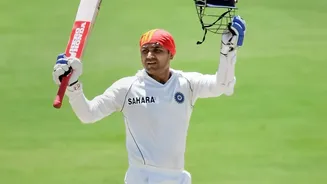
When Virender Sehwag first broke into the Indian team in the late 1990s and early 2000s, he was a hard-hitting middle-order batsman. He even scored a brilliant century on his Test debut against South Africa in 2001 while batting at number six. The talent
was undeniable, but there was a significant problem: India's middle order was arguably the greatest in its history. With legends like Sachin Tendulkar, Rahul Dravid, Sourav Ganguly, and VVS Laxman occupying the slots from three to six, finding a permanent place for a young, aggressive player like Sehwag was a strategic nightmare. He had the potential to be a match-winner, but he was struggling to find a consistent spot in the playing eleven.
A Captain's Masterstroke
The Indian team at the time, led by the astute Sourav Ganguly, faced another persistent issue: the lack of a stable and aggressive opening partner in both ODIs and Tests. Ganguly, along with coach John Wright, saw a potential solution in Sehwag's fearless, hand-eye coordinated batting style. According to some accounts, the initial idea to try Sehwag at the top was suggested by his teammate, fast bowler Zaheer Khan. Ganguly recognised that Sehwag’s ability to attack the new ball could put immediate pressure on the opposition, giving India a powerful advantage early in the innings. It was a bold, unconventional idea to take a player known for his middle-order exploits and throw him into the fire against fresh bowlers and a brand new ball.
The All-Important Conversation
Convincing Sehwag was not straightforward. He had never opened the batting before in his career and was naturally reluctant. He questioned the decision, asking Ganguly why established openers like him or Tendulkar couldn't continue in that role. Ganguly's pitch was a mix of brutal honesty and unwavering support. He explained that the middle order was packed and that the only vacant spot was at the top. To ease Sehwag's fears of being dropped after a couple of failures, Ganguly made a crucial promise: he would be given a fair run of three to four matches to prove himself as an opener. If it didn't work out, Ganguly assured him, he would get another chance back in the middle order. This guarantee of security gave Sehwag the confidence to accept the challenge.
The Experiment Begins
The move was first trialled in one-day cricket during a tri-series in Sri Lanka in 2001. With Sachin Tendulkar injured, the opening slot was available. After a few others failed to make an impact, Sehwag was promoted. It didn't take long for the gamble to pay off. In just his fourth match as an opener, he smashed his maiden ODI century off only 70 balls, signalling his arrival as a top-order force. The success in the shorter format gave the team management the confidence to implement the plan in Test cricket. The stage was set during India’s tour of England in 2002. Opening for the first time in a Test match at the historic Lord's, Sehwag scored a blistering 84, silencing any remaining doubters and confirming his new role.
Redefining the Opener's Role
Sehwag didn't just become an opener; he completely revolutionised the position. Traditionally, Test openers were expected to be cautious, see off the new ball, and build a foundation. Sehwag did the opposite. He attacked from the very first delivery, dismantling bowling attacks and scoring runs at a pace previously unheard of in Test cricket. His approach not only won matches for India but also changed the psychology of the game. As former coach John Wright famously put it, 'Sehwag didn't redefine his game because of his batting position. He redefined the position with his batting'. His success, including two triple centuries, cemented his legacy as one of the greatest and most impactful opening batsmen in the history of cricket.