



The Universe's Building Blocks
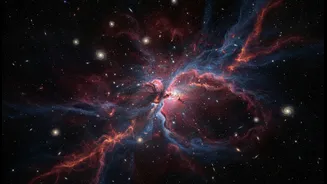
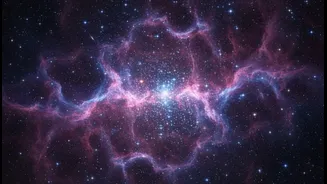
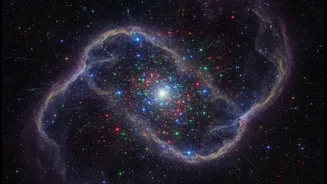
To understand the universe, it helps to know how its most fundamental components are made. Stars are not born in isolation. They form in groups called clusters, born from vast, cold clouds of gas and dust that collapse under their own gravity. These clusters can
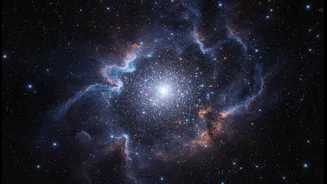
range from small, loosely bound groups known as open clusters, to massive, dense spheres called globular clusters, which can contain millions of stars. These stellar nurseries are the basic units of star formation. For a long time, astronomers believed that different types of clusters formed through unique mechanisms. However, recent thinking suggests a more unified model where the environment, especially pressure, dictates the type of cluster that is formed.
A Cosmic Growth Spurt
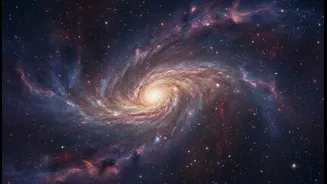
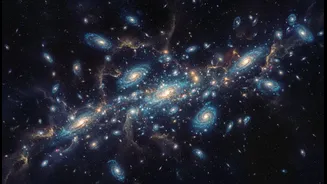
The prevailing theory of galaxy formation is one of hierarchical assembly: small things merge to create bigger things. Just as streams join to form rivers, and rivers flow into oceans, astronomers believe small proto-galaxies and gas clouds merged over billions of years to build the massive galaxies we see today. Within this framework, star clusters are not just passive residents; they are active participants. The intense radiation and powerful winds from the massive young stars within these clusters, a process called 'stellar feedback', can blow away surrounding gas, either shutting down further star formation in the area or triggering it elsewhere. This makes understanding clusters crucial to understanding how galaxies regulate their own growth.
Looking Back in Time
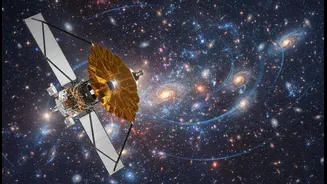
The challenge for astronomers is that this galactic assembly happened billions of years ago. Luckily, because light takes time to travel across the vastness of space, powerful telescopes act as time machines. When we look at a galaxy 10 billion light-years away, we see it as it was 10 billion years ago. Thanks to new instruments like the James Webb Space Telescope (JWST), scientists can now peer into the very early universe and see the ancestors of today's star clusters, known as proto-globular clusters. In June 2024, astronomers announced the discovery of five such young clusters in a galaxy that existed just 460 million years after the Big Bang, providing a direct window into this ancient construction process.
New Tools, New Insights
The combined power of the Hubble Space Telescope and the JWST has been revolutionary. While Hubble excels at seeing exposed clusters in visible light, Webb’s infrared vision can pierce through the dust clouds that shroud the youngest, still-embedded clusters. By combining data from both, scientists can study the entire life cycle. A recent study of nearly 9,000 clusters in four nearby galaxies revealed a surprising pattern: the most massive clusters emerge from their dusty nurseries faster than smaller ones. It takes massive clusters about five million years to clear their gas, while less massive ones take up to eight million years. This detail provides a crucial new constraint for computer models that simulate how galaxies evolve, refining our understanding of how quickly and powerfully these clusters begin to shape their parent galaxies.
From Clusters to Cosmos
The evidence increasingly points to a scenario where the ancient globular clusters we see today, orbiting galaxies like our own Milky Way, are the survivors of this early, chaotic period. They formed in the high-pressure, gas-rich environments of young, interacting galaxies. Many of their smaller siblings would have been torn apart over time by gravitational forces, their stars dispersing to become part of the galaxy's general population. By studying the chemistry and distribution of both young clusters in distant galaxies and ancient clusters closer to home, scientists can piece together a violent history of galactic mergers and acquisitions. These young clusters are not just pretty objects; they are fossil records of their host galaxy's star formation history.