
A Mission's Celebrated First Act
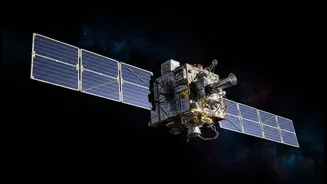
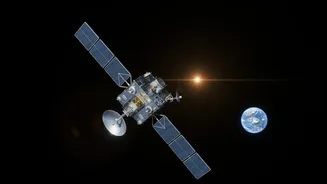
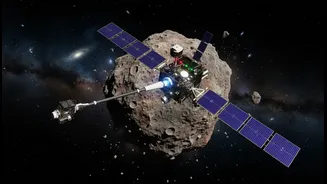
To appreciate the significance of this new chapter, it's worth remembering Hayabusa2's initial triumph. Operated by the Japan Aerospace Exploration Agency (JAXA), the spacecraft launched in 2014 with an ambitious goal: to visit the near-Earth asteroid
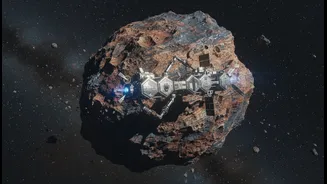
Ryugu, collect samples, and bring them home. It arrived at the diamond-shaped asteroid in 2018 and spent a year and a half conducting an intensive survey. The mission deployed tiny hopping rovers and even fired a projectile to create an artificial crater, allowing it to collect pristine subsurface material shielded from space weathering. In December 2020, a capsule containing these precious black grains of Ryugu landed safely in Australia, delivering a scientific treasure trove that is helping scientists understand the formation of our solar system and the origins of life.
The Encore: A High-Speed Asteroid Encounter
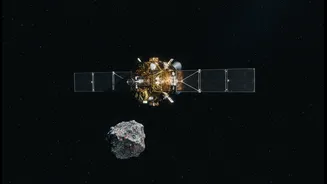
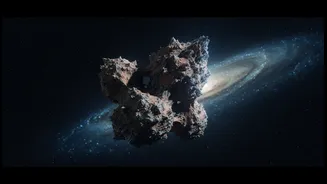
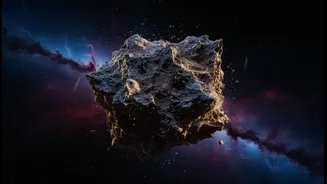
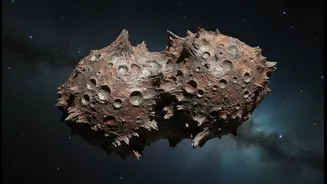
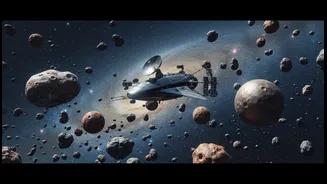
Most missions would end there, but JAXA had other plans. With the spacecraft still healthy and retaining about half its fuel, it was sent on an extended mission. The first major objective of this new phase, dubbed Hayabusa2#, was a high-speed flyby of another near-Earth asteroid on July 5, 2026. The target was (98943) Torifune, also known as 2001 CC21, an elongated, two-lobed rock about 450 meters in diameter. The name Torifune comes from a Japanese deity whose ship could travel safely at high speeds—a fitting title for this daring encounter. The spacecraft zipped past the asteroid at a relative speed of about 5 kilometers per second, coming as close as 800 meters from its center.
More Than Just a Flyby
This was no simple sightseeing trip. The flyby was a crucial test of technology and a valuable scientific opportunity. The maneuver pushed the spacecraft's capabilities, as it was originally designed for slow rendezvous operations, not high-speed intercepts. Mission engineers had to rely on advanced autonomous optical navigation to track the dark, fast-moving target in the final days of approach. The successful flyby served as a critical technology demonstration for planetary defense. The ability to precisely guide a spacecraft to a small, fast-moving object is a key skill needed to one day intercept and deflect an asteroid that poses a threat to Earth, much like NASA's DART mission demonstrated.
The Blueprint for Frugal Exploration
Hayabusa2's second life is a powerful demonstration of how to maximize the return on investment in space exploration. Building and launching sophisticated spacecraft costs hundreds of millions of dollars. By repurposing a proven vehicle for new scientific objectives, space agencies can gather more data for a fraction of the cost of a new mission. This extended mission is not just adding to our photo album of the solar system; it’s providing crucial data on a different type of asteroid and testing technologies vital for protecting our planet. It’s a model of sustainability and efficiency, proving that with careful planning and robust engineering, a single mission can have multiple acts. Despite the spacecraft's systems degrading from age and radiation, it continues to perform.
What's Next for the Veteran Explorer?
The Torifune flyby is just a stepping stone. After a pair of Earth swing-bys in 2027 and 2028, Hayabusa2 will continue its journey toward a final, even more challenging target. In July 2031, it is scheduled to rendezvous with 1998 KY26, a tiny, rapidly rotating asteroid just 11 meters in diameter. This object would be the smallest asteroid ever visited up-close by a probe. Its extremely fast rotation presents a unique scientific environment, where the centrifugal force at its surface may exceed its own gravity. Exploring this micro-world will not only test the limits of the aging spacecraft but will also provide invaluable insights into the diverse population of objects that share our cosmic neighborhood.