




More Than Just Another Flyby
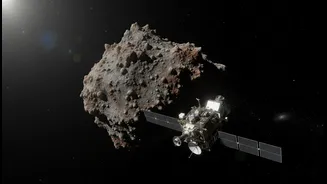
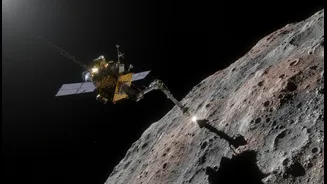
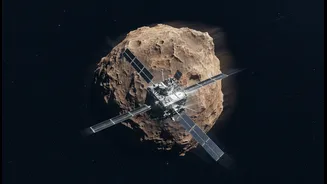
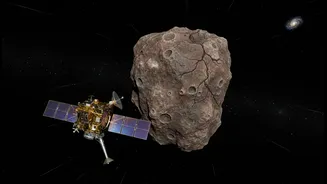
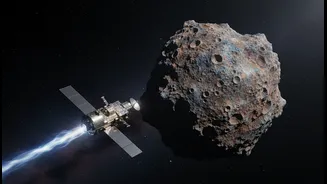
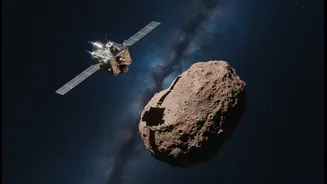
At its core, the July 5 event was a remarkable technical feat. JAXA's Hayabusa2, a probe famous for returning samples from asteroid Ryugu in 2020, is now on an extended mission. This new phase saw it fly within an incredibly close distance of Torifune,
a 450-meter near-Earth asteroid, at a blistering speed of over 18,000 kilometers per hour. This wasn't a rendezvous, where a spacecraft gently matches an asteroid's orbit. It was a high-stakes, high-speed pass designed to test the very limits of the spacecraft and its navigation team on the ground. The probe was not originally built for this kind of fast flyby, making the successful maneuver a significant engineering accomplishment in its own right.
A Dress Rehearsal for Planetary Defense
The most crucial aspect of the Torifune encounter is its role in planetary defense. An asteroid of Torifune's size could cause significant damage if it were to hit Earth, and this flyby was a critical test of our ability to respond to such a threat. The primary goal was to prove that a spacecraft can be navigated with extreme precision to a small, fast-moving target. This capability is fundamental for future missions that might need to intentionally impact an asteroid to alter its course, a technique known as a kinetic impactor. Think of it as a crucial practice run for a scenario humanity hopes to never face. By mastering high-precision guidance now, missions like Hayabusa2 provide invaluable data for protecting our planet.
The Science of a 'Snowman' Asteroid
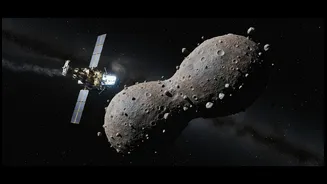
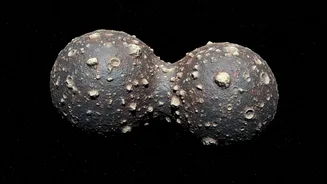
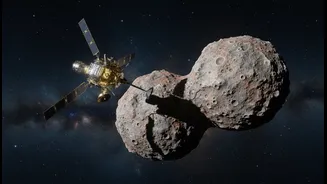
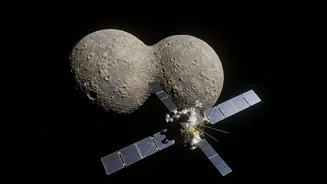
Even in a brief pass, the scientific return is immense. Early images revealed Torifune to be a fascinating 'contact binary'—essentially two separate asteroids that have gently collided and stuck together, forming a shape resembling a snowman or a peanut. This provides planetary scientists with a real-life laboratory for understanding how small bodies in the solar system might grow into larger objects, and eventually, planets. Instruments on Hayabusa2, including a near-infrared spectrometer and a thermal imager, collected data on the asteroid's composition, surface temperature, and texture. This information, still being transmitted back to Earth, will help scientists characterize a class of near-Earth asteroids that are difficult to study in detail from the ground.
The Journey Ahead for a Veteran Probe
The Torifune flyby is not the end of the road for this resilient explorer. It was a stepping stone toward Hayabusa2's ultimate destination in its extended mission: a rendezvous with an even more challenging target in 2031. That target, an asteroid named 1998 KY26, is an ultra-small and rapidly rotating object, estimated to be only about 11 to 30 meters in diameter. Exploring such a tiny world will be a world-first and will push the boundaries of space exploration even further. The skills and confidence gained from the successful Torifune maneuver are essential for preparing for this final, ambitious encounter a decade from now, which will also contribute to our knowledge of how to handle small but potentially hazardous asteroids.