
The Old Way: The Burden of Chemical Fuel
Traditionally, satellites have navigated space using chemical propulsion. Think of it like a conventional car engine, but for space. It works by mixing a fuel and an oxidiser, causing a powerful chemical reaction that produces a high-thrust burst of energy.
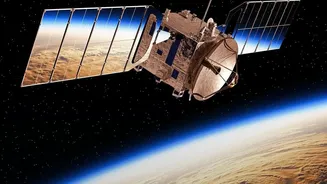
This method is excellent for getting a heavy satellite from a lower temporary orbit to its final destination, like the geostationary orbit 36,000 km away, relatively quickly. However, this power comes at a significant cost: weight. For a typical 5,000 kg communication satellite, a staggering amount of its launch mass can be just chemical propellant. This fuel is not only used for the initial orbit-raising but also for tiny adjustments throughout the satellite's life, known as station-keeping, to counteract gravitational pulls and maintain its precise position. Once this fuel runs out, the satellite's useful life is over, even if its electronic components are still perfectly functional.
The Electric Revolution: A Marathon, Not a Sprint
Electric propulsion (EP) systems work on a completely different principle. Instead of a powerful chemical explosion, they use electrical power, typically generated by the satellite's solar panels, to accelerate and expel tiny amounts of propellant, such as the inert gas Xenon. Two popular types are Hall-effect thrusters and ion thrusters. They essentially create a stream of electrically charged particles (ions) and shoot them out at incredibly high speeds—up to twenty times faster than the exhaust from a chemical rocket. The resulting thrust is very gentle, often compared to the force of a single piece of paper resting on your hand. While a chemical thruster is a sprinter, providing a massive push for a short time, an electric thruster is a marathon runner, providing a steady, gentle push over weeks, months, or even years.
The Magic of Saving Mass
The incredible efficiency of electric propulsion is its defining advantage. Because the propellant is ejected at such high velocity, a tiny amount goes a very long way. This efficiency is measured by a metric called specific impulse, and EP systems have a specific impulse that can be at least six times higher than their chemical counterparts. This means a satellite needs to carry significantly less propellant mass to achieve the same change in velocity over its mission. For instance, a satellite that might need over 2,000 kg of chemical fuel for its operational life could potentially achieve the same mission with just a few hundred kilograms of Xenon. This drastic weight reduction has a cascading effect. A lighter satellite is cheaper to launch, as launch costs are directly tied to mass. Alternatively, the mass saved on fuel can be reallocated to what really matters: the payload. This allows ISRO to pack more transponders, more powerful sensors, or more scientific instruments onto a satellite of the same size.
More Life, More Value
The fuel efficiency of electric propulsion directly translates to a longer mission lifespan. For commercial communication satellites, which are a major focus for ISRO and its commercial arm NSIL, a longer life means more years of revenue-generating service. Standard missions are often designed for 15 years, limited by the amount of chemical propellant needed for station-keeping. By using hyper-efficient electric thrusters for these routine orbital adjustments, the operational life of a satellite can be extended significantly, sometimes by an additional 5 to 10 years. This not only improves the return on investment for each satellite but also ensures a more robust and resilient communications infrastructure for the nation, supporting everything from broadband internet to in-flight connectivity.
ISRO's Electric Fleet in Action
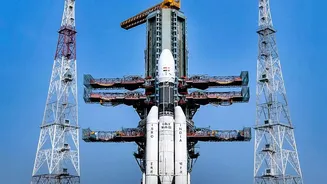
ISRO has been strategically moving towards self-reliance in this critical technology. While it first tested an imported electric thruster on the GSAT-9 satellite in 2017, the agency has since focused on developing its own, more powerful systems. A major milestone was the development of a 300-millinewton Stationary Plasma Thruster, which successfully completed a 1,000-hour endurance test in early 2025, proving its reliability for long-duration missions. This indigenous system is slated for demonstration on the Technology Demonstration Satellite (TDS-01). Looking ahead, satellites like GSAT-20 are being designed to be lighter thanks to the eventual integration of this technology, enabling India's own powerful rockets, like the GSLV Mk III, to launch them. This reduces reliance on foreign launch providers and marks a crucial step toward full self-sufficiency in space.