







The Initial Glimpse: A Dot in the Darkness
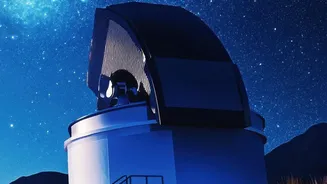
The hunt for a new asteroid begins not with a person peering through an eyepiece, but with automated, wide-field telescopes. Projects like the Catalina Sky Survey and Pan-STARRS continuously scan the night sky, taking a series of images of the same patch
of space minutes apart. Software then compares these images, looking for any point of light that has moved against the fixed background of distant stars and galaxies. That moving dot is the first clue that a Near-Earth Object (NEO) might be passing by. This initial detection is often faint and fleeting, a tiny celestial traveler making its presence known across millions of kilometres.
The Global Switchboard: Reporting the Find
Once a potential asteroid is spotted, the discovery data is immediately sent to a single, crucial hub: the Minor Planet Center (MPC). Operated under the authority of the International Astronomical Union, the MPC is the world's official clearinghouse for all observations of minor planets and comets. Its job is to collect these preliminary positional measurements from observatories around the globe and post them on a public page for other astronomers to see. This acts as a global alert, telling the astronomical community, "We've found something new. We need more eyes on it."
Confirmation and Calculation: Charting a Path
With the alert out, a global network of both professional and amateur astronomers springs into action. They point their telescopes to the coordinates provided by the MPC to get more observations of the object. A minimum of three separate observations is usually needed to begin calculating a preliminary orbit. The more data that comes in over subsequent hours and days, the more precise the object's trajectory becomes. At this stage, NASA's Scout system plays a key role. It rapidly analyzes the early data for unconfirmed objects to provide a preliminary assessment of any short-term impact risk over the coming days and weeks.
From 'Object' to 'Risk': Assessing the Threat
Once an object is officially confirmed with a solid orbit, it is passed from the Scout system to Sentry. Sentry is NASA's highly automated impact monitoring system that analyzes the orbits of confirmed NEOs for the next 100 years. It calculates the probability of a future impact with Earth by running simulations across a range of possible orbits, because even the best data has a small margin of error. For most asteroids, the impact risk is quickly ruled out as more observations refine the orbit. But for a very small number, the risk remains, turning them into Potentially Hazardous Asteroids that require close and continuous monitoring.
The Final Plunge: A Fiery End
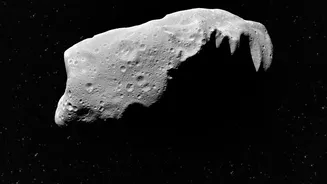
Most asteroids that enter our atmosphere are small, burning up harmlessly. An asteroid becomes a meteor—or shooting star—as it vaporizes due to atmospheric friction. For the rare few tracked all the way to impact, like asteroid 2018 LA, scientists can predict the impact zone with remarkable accuracy. As the rock streaks through the sky, it heats up to thousands of degrees, creating a spectacular fireball. The object disintegrates, scattering fine dust into the atmosphere that eventually settles on the ground. For scientists, this isn't an end, but a treasure trove of data. Observing a burn-up provides invaluable information about an asteroid's composition and structure, helping to refine planetary defense models for the future.