



The All-or-Nothing Phenomenon
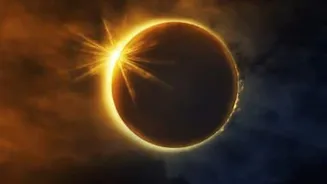
A solar eclipse happens when the New Moon passes between the Sun and Earth, casting a shadow on our planet. If you are lucky enough to be in the centre of this shadow (the umbra), you witness a total solar eclipse. For a few precious minutes, the Moon perfectly
blocks the Sun's bright face. But if you are outside this narrow path, in the lighter shadow (the penumbra), you only see a partial eclipse. Experts say that experiencing a 99% partial eclipse is only 1% as spectacular as totality. It is a completely different event. A partial eclipse is interesting, but a total eclipse is a life-changing spectacle.
The Magic of Totality
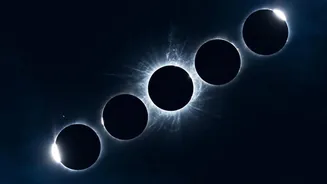
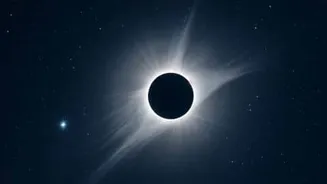
Being in the path of totality is an immersive, multi-sensory experience. As the last sliver of the Sun vanishes, day turns into an eerie twilight. The temperature can drop noticeably. Bright stars and planets may become visible in the sky. For those brief moments of totality, the Sun’s magnificent outer atmosphere, the corona, becomes visible—a wispy, pearly-white crown of light that is otherwise hidden by the Sun's glare. Just before and after totality, observers might see phenomena known as Baily's Beads or the Diamond Ring effect, where the last rays of sunlight stream through the valleys on the Moon's edge. It is a dramatic and profound event that has captivated humans for millennia.
The Partial View: A Different Sight
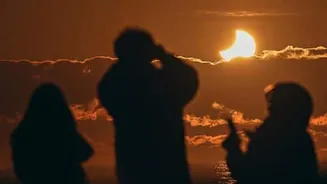
Most people who witness an eclipse see a partial one. During this event, the Moon only covers a part of the Sun, making it look like a bite has been taken out of it. The sky might dim slightly, similar to an overcast day, but it does not get dark. Even when 90% of the sun is covered, the remaining 10% is still incredibly bright, preventing the dramatic effects of totality. While still a fascinating event, it lacks the awe-inspiring transformation of the surrounding environment. An interesting effect to look for during a partial eclipse is crescent-shaped shadows projected onto the ground through the leaves of trees.
Eclipse Viewing on August 12, 2026
Unfortunately, the total solar eclipse of August 12, 2026, will not be visible from India. The path of totality, a narrow band about 294 km wide, will cross over the Arctic, Greenland, Iceland, the Atlantic Ocean, and northern Spain. For those in this path, the total blackout will last for a maximum of about two minutes and 18 seconds. A partial eclipse will be visible across most of Europe, northwestern Africa, and parts of North America. For skywatchers in India, the next opportunity to see a partial solar eclipse will be on August 2, 2027.
Safety First: Never Look Directly at the Sun
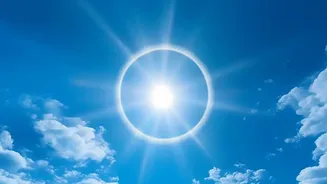
Whether the eclipse is total or partial, it is never safe to look directly at the Sun without proper eye protection, except during the brief moments of 100% totality. Regular sunglasses are not safe. To view any partial phase of an eclipse, you must use certified solar viewing glasses (often called 'eclipse glasses') or a handheld solar viewer that meets the ISO 12312-2 international safety standard. An alternative is to project an image of the Sun. You can do this simply by creating a pinhole in a piece of card and letting the sunlight pass through it onto another surface, like the ground or another card. Never look at the Sun through the pinhole itself.