


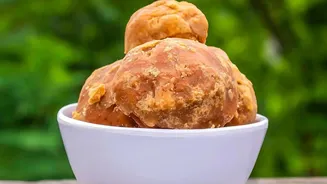
The Tradition of Gur in Winter
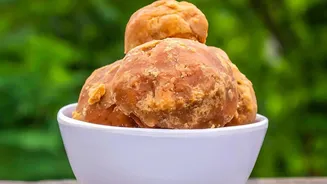
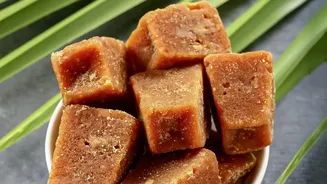
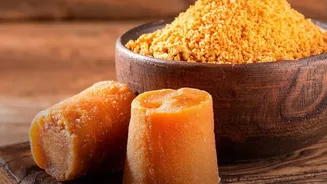
Come winter, and a familiar shift happens in our pantries. The pristine white crystals of sugar are often pushed aside for the rustic, golden-brown blocks of jaggery. It sweetens our tea, finds its way into til-gud ladoos and chikki, and is consumed after
meals, believed to aid digestion. This practice is rooted in the traditional belief that jaggery has 'warming' properties, making it an ideal companion for the colder months, potentially helping to ward off seasonal coughs and colds. This cultural embrace of gur gives it a health halo that refined sugar simply doesn't have.
How They Are Made: The Core Difference
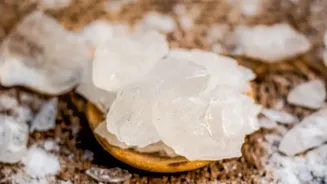
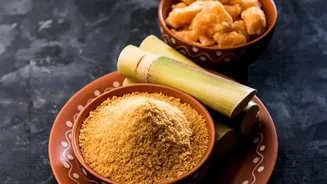
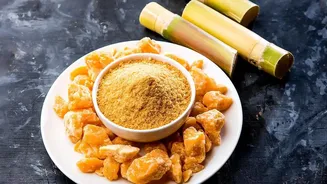
The primary distinction between jaggery and white sugar lies in their processing. Both originate from sugarcane juice, but their paths diverge significantly from there. Jaggery is produced by simply boiling sugarcane juice in large, open pans until it thickens and solidifies. This minimal processing means it retains the molasses, which is naturally present in sugarcane juice and gives jaggery its characteristic colour and flavour. In stark contrast, white sugar undergoes extensive industrial refining. This multi-step process involves chemical clarification, filtration, and bleaching to strip away the molasses and all other components, resulting in pure, white sucrose crystals. It is essentially a process of addition by subtraction; everything that isn't pure sucrose is removed.
The Mineral Myth and Nutritional Reality
Because it retains molasses, jaggery does contain trace minerals that are absent in white sugar. These include small amounts of iron, potassium, magnesium, and calcium. Some reports show jaggery can contain a notable amount of iron, which seems significant in a country with high rates of iron deficiency. However, it's crucial to look at the quantity. To get a meaningful dose of these minerals, you would have to consume an unhealthily large amount of jaggery. Spoon for spoon, the nutritional benefit is marginal. White sugar, being almost 99.9% sucrose, offers what nutritionists call 'empty calories'—energy with virtually no other nutrients.
The Calorie and Blood Sugar Spike
Here is where the health halo of jaggery begins to fade. Calorie-wise, there is almost no difference. A 100-gram serving of jaggery has around 383 calories, while the same amount of white sugar has about 387 calories. The most surprising fact for many is the Glycemic Index (GI), which measures how quickly a food raises blood sugar levels. Contrary to popular belief, most common sugarcane jaggery has a high GI, often reported to be around 84. This is actually higher than white sugar, which has a GI of about 65. This means that jaggery can cause a faster and sharper spike in blood sugar, making it just as risky as white sugar for individuals with diabetes.
Does Brown Really Mean Better?
The colour of jaggery comes from the molasses left behind during its simple processing, and it's this molasses that holds the trace minerals. So, in a very technical sense, the colour does signify the presence of more nutrients compared to the stark white of refined sugar. However, this does not translate into a significant health advantage in the amounts we typically consume. Both jaggery and white sugar are, at their core, concentrated forms of sugar. Your body metabolises the sucrose in both in a very similar way. The idea that one is a 'health food' and the other is not is a dangerous misconception, especially for those managing their weight or blood sugar levels.
The Verdict: Moderation Over Substitution
So, is jaggery better than white sugar? The answer is a qualified 'slightly'. Its advantage lies in being less processed and containing a handful of minerals. If you must use a sweetener, jaggery is a marginally better choice than refined sugar. However, it is not a free pass to indulge. The belief that you can use more jaggery because it's 'healthy' is a trap that can lead to consuming more sugar and calories than you otherwise would. For people with diabetes, jaggery should be treated with the same caution as white sugar. The true health win isn't in swapping one for the other, but in reducing the overall intake of all added sugars in our diet.