




The Foundation: Why a Stable Platform Is Crucial
The first rule of a successful step-up is to choose your surface wisely. Using a wobbly chair, an unstable stack of books, or a slick surface is a direct path to injury. A stable platform ensures that the force you generate goes into working your muscles,
not into fighting to keep your balance. Any instability underfoot can lead to slips, falls, and acute injuries like a twisted ankle or a strained knee. For home workouts, a sturdy weight bench, a plyo box, or even the bottom step of a staircase are excellent options. The surface should have a non-slip top and be heavy enough that it won't shift as you move. Your entire foot, from heel to toe, should fit comfortably on the platform; a dangling heel compromises stability and shifts stress to the knee joint. By securing your foundation, you create a safe environment where you can focus on the quality of the movement itself.
The Engine: The Art of Controlled Movement
Once your platform is set, the focus shifts to how you move. The biggest mistake people make with step-ups is using momentum. Bouncing off the back foot to launch yourself up or crashing back down with gravity cheats the muscles of valuable work and increases injury risk. Proper form demands that the leg on the platform does almost all the work. This is a unilateral exercise, designed to build single-leg strength and correct imbalances between your left and right sides. The movement should be deliberate and controlled in both directions. The 'up' phase (concentric) involves driving through the heel of your front foot to lift your body. The 'down' phase (eccentric) is just as important; lowering your body slowly, over two to three seconds, builds strength and stability. This control ensures you are using muscle, not momentum, which is the key to both results and safety.
Your Guide to the Perfect Step-Up
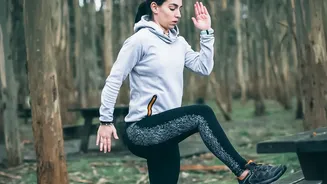
Ready to put it all together? Here is a step-by-step guide to performing the exercise correctly. First, choose a step height where your knee is bent at roughly a 90-degree angle when your foot is on top. A lower step is always better when you are starting out. Stand tall in front of the platform and place your entire right foot firmly on the surface. Brace your core and keep your chest up, with a slight forward lean from the hips. Drive through the heel of your right foot to stand up, bringing your left foot to meet it. Squeeze your glutes at the top. The key is to avoid pushing off with your left foot on the floor. To ensure this, you can even try lifting the toes of your back foot slightly before you begin the movement. Then, reverse the motion with control, lowering your left foot back to the floor slowly before bringing your right foot down. Perform all reps on one side before switching.
Unlocking the Benefits of Proper Form
When performed with a stable base and controlled tempo, the step-up becomes one of the most functional and effective exercises in your arsenal. It builds serious strength in your major leg muscles: the quadriceps, hamstrings, and especially the glutes. As a unilateral movement, it is fantastic for identifying and correcting strength imbalances between your legs, which can reduce your overall risk of injury. It also enhances balance, stability, and coordination by forcing the small stabiliser muscles in your hips and core to engage. Unlike some higher-impact exercises, step-ups can be easier on the lower back and joints, making them a great alternative to movements like plyometric jumps. This functional strength translates directly to everyday activities like climbing stairs, hiking, or lifting objects from the ground.
Common Mistakes to Watch For and Correct
Beyond an unstable platform and using momentum, a few other common form errors can sabotage your results. One is letting the working knee cave inward as you step up, a movement pattern known as knee valgus. To fix this, consciously keep your knee aligned over your middle toe. Another error is choosing a box that is too high. If you have to excessively lean forward or round your back to get up, the step is too high for you. This shifts the load away from your legs and onto your lower back. Finally, avoid placing only the ball of your foot on the step. This creates an unstable base and reduces the powerful contribution of your glutes and hamstrings. Always plant your entire foot. By being mindful of these details, you ensure every rep is a quality rep.