

A Panoramic Window to the Cosmos
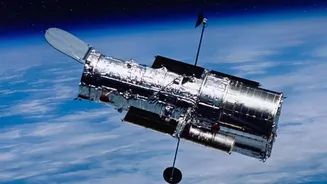
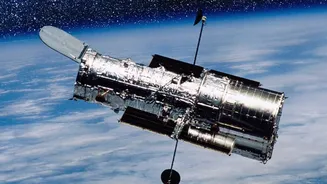
Imagine trying to take a picture of a sprawling landscape through a drinking straw. That’s been the challenge for telescopes like Hubble and the James Webb Space Telescope (JWST). They provide incredibly sharp, deep, and detailed views, but only of minuscule
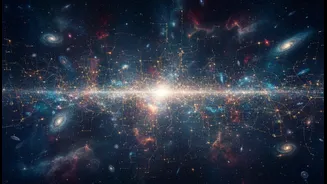
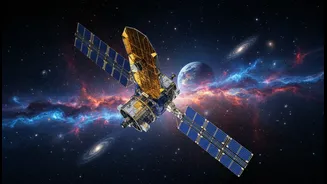
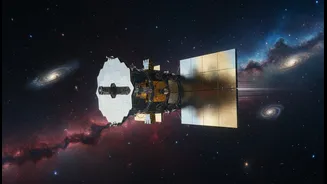
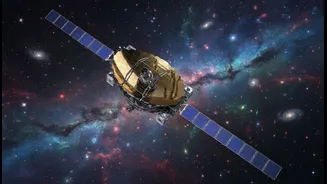
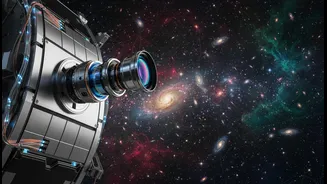
patches of the sky at a time. The Nancy Grace Roman Space Telescope, set for launch on August 30, 2026, is built to solve this problem. Its primary feature is a colossal field of view. Armed with a 300-megapixel Wide Field Instrument, Roman can capture an area of the sky 100 times larger than Hubble can in a single snapshot, all with the same stunning resolution. One NASA scientist noted that a month of observing time on Roman will be equivalent to a century on Hubble. This isn't about replacing Hubble or Webb; it's about complementing them. Roman is a survey telescope, designed to create vast cosmic maps that other telescopes can then explore in greater detail. It will conduct the first wide-field maps of the universe at space-based resolution.
Hunting for Cosmic Phantoms: Dark Energy and Dark Matter
About 95% of the universe is composed of dark energy and dark matter, mysterious substances that scientists cannot directly see or explain. Roman's primary mission is to tackle these profound puzzles head-on. Dark energy is the enigmatic force believed to be causing the expansion of the universe to accelerate. Roman will investigate this by observing billions of galaxies and thousands of exploding stars called supernovae. By measuring how the distribution of galaxies has changed over cosmic history and precisely calculating distances using supernovae, astronomers can trace the influence of dark energy over time. The telescope will use several methods, including mapping the echoes of ancient sound waves from the early universe, to create the most extensive 3D map of the cosmos ever attempted. This unprecedented survey will help scientists determine if dark energy is a constant force or if it has changed over billions of years, providing critical clues to the ultimate fate of our universe.
The Ultimate Exoplanet Census
While telescopes like Kepler and TESS have found thousands of planets by watching for stars to dim as a planet passes in front, this 'transit method' is biased towards finding planets that orbit very close to their stars. Roman will employ a different and powerful technique called gravitational microlensing. This method watches for moments when a foreground star and its planets pass in front of a more distant background star. The gravity of the foreground system acts like a lens, briefly magnifying the light of the background star. The precise way the light brightens and fades can reveal the presence, mass, and orbit of planets. Because this technique doesn't depend on light from the planet itself, Roman will be sensitive enough to find planets much farther from their stars, in the cold outer regions of solar systems, and even rogue planets that float through the galaxy untethered to any star. Scientists anticipate Roman will discover thousands of new worlds, including some potentially as small as Mars, providing a complete census of planets in our galaxy.
A Technology Powerhouse
At its heart, Roman is based on a 2.4-meter mirror—the same size as Hubble's—that was donated to NASA by the National Reconnaissance Office. But its instrumentation is what sets it apart. Beyond the Wide Field Instrument, Roman will also carry a technology demonstration called the Coronagraph Instrument. This device is designed to block the overwhelming glare of a star, allowing the telescope to directly image the faint planets orbiting it. The coronagraph on Roman will be at least 100 times more powerful than any similar instrument, capable of spotting planets a billion times dimmer than their host stars. While this instrument will focus on a small number of nearby systems, it serves as a crucial testbed for technologies that will be used in future missions, like the planned Habitable Worlds Observatory, which aims to find and characterize Earth-like planets around other stars.