




A Sugar Found 27,000 Light-Years Away
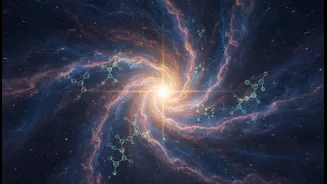
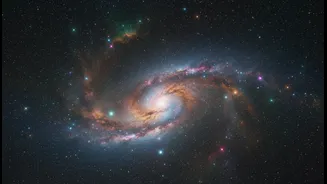
Using powerful radio telescopes in Spain, an international team of scientists peered into a dense cloud of gas and dust near the center of our Milky Way galaxy. In this molecular cloud, known as G+0.693-0.027, they detected the faint chemical signature
of erythrulose, a four-carbon sugar. On Earth, this molecule is found in raspberries and is used in sunless tanning lotions, but its presence in deep space marks the first time a true sugar has been found in the interstellar medium. While sugars have been found in meteorites before, detecting one freely floating in the nursery from which stars and planets are born confirms that the building blocks of life can exist long before planets form.
Why This Cosmic Sugar Matters
The discovery is about more than just cataloging space chemicals. Sugars are fundamental to life as we know it. They serve as a source of metabolic energy and, crucially, form the structural backbone of RNA and DNA, the molecules that carry the blueprints of life. Scientists have long wondered how the first sugars formed on the primitive Earth, as lab experiments suggest they wouldn't have been produced in sufficient quantities. The discovery of erythrulose in space supports a tantalizing theory: that key ingredients for life were delivered to Earth from space, perhaps by comets or meteorites during the planet's early, chaotic history.
The Puzzle of Molecular 'Handedness'
Simply finding erythrulose is a triumph, but it immediately raises a more complex question about a property called chirality. Like your hands, some molecules are mirror images of each other; they are chemically identical but not superimposable. Life on Earth shows a strong preference for one 'hand' over the other—for example, using almost exclusively 'right-handed' sugars in its DNA. Erythrulose is a chiral molecule, only the second one ever detected in interstellar space. The discovery proves chiral molecules can form out there, but the next great challenge is to determine if space has a preference for one hand over the other. Answering this could help explain why life on Earth developed its own specific handedness.
Rewriting the Interstellar Cookbook
The discovery also challenges long-held ideas about how complex molecules form in space. The prevailing theory was that they grow incrementally, with smaller molecules adding one carbon atom at a time. However, the team found that four-carbon erythrulose was significantly more abundant than any three-carbon sugars, which were not detected at all. This suggests a different recipe is at play. New models indicate that erythrulose likely forms on the icy surfaces of tiny dust grains when two-carbon molecules combine. This rewrites our understanding of chemical complexity in the cosmos, showing that larger, more life-relevant molecules can be built more directly than previously thought.
The Search for Life's Ultimate Precursor
The detection of erythrulose is a significant milestone, not an endpoint. It proves that a four-carbon sugar can form in interstellar space. For astrobiologists, this is a green light to hunt for even more complex and relevant molecules. The ultimate prize would be the detection of ribose, the five-carbon sugar that forms the backbone of RNA, a leading candidate for the first genetic material in early life. The discovery of erythrulose makes the prospect of finding ribose seem much less like science fiction and more like the next frontier. It suggests the chemical path leading from simple stardust to the building blocks of life may be a universal one.