





The Challenge of Staying in Orbit
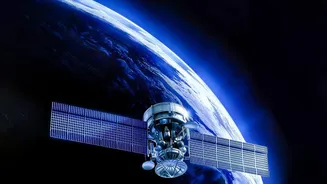
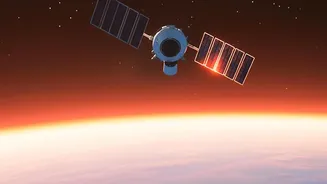
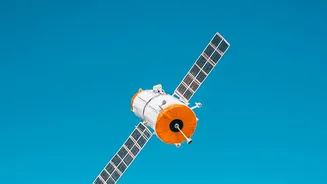
Once a satellite is launched into space, its journey has only just begun. Contrary to the popular image of objects floating effortlessly forever, satellites in Earth orbit are in a constant battle. They face the pull of gravity, atmospheric drag even
at high altitudes, and the gravitational influence of the sun and moon. These forces cause a satellite's orbit to decay, meaning it gradually loses altitude and would eventually fall back to Earth if left uncorrected. To counteract this, satellites need their own engines, or thrusters, to perform regular manoeuvres. This essential function, known as 'station-keeping', is crucial for maintaining the precise orbital path required for communication, observation, or scientific missions. The amount of fuel a satellite can carry for these thrusters has historically been the single biggest factor limiting its operational lifespan.
Old School vs. New Fuel
For decades, satellites have relied on chemical propulsion systems. These thrusters work by burning a liquid fuel and an oxidizer, creating a powerful burst of hot gas that provides strong thrust. While effective for large orbital changes, chemical thrusters have a major drawback: they are fuel-guzzlers. The propellant is heavy and bulky, which means a significant portion of a satellite's launch weight is just its fuel tank. For smaller, lighter satellites, this is a huge constraint. Carrying enough chemical fuel for a 10- or 15-year mission becomes impractical, as it leaves little room for the actual scientific instruments or communication transponders—the very reason the satellite was launched. This is where a more elegant and efficient solution comes into play: electric propulsion.
Enter the Plasma Thruster
Instead of a violent chemical reaction, electric propulsion systems, including plasma thrusters, use electricity to create thrust. One of the most promising types is the Hall-effect thruster. It works by using solar panels to generate electricity, which is then used to create powerful electric and magnetic fields within the thruster. A small amount of inert gas, typically xenon, is fed into a channel. The magnetic field traps electrons, which then collide with the xenon atoms, stripping away their electrons and turning them into positively charged ions—creating a state of matter known as plasma. An electric field then accelerates these ions at incredibly high speeds, shooting them out of the back of the thruster. While the force, or thrust, produced at any given moment is very gentle—often compared to the force of a piece of paper resting on your hand—it is continuous and extraordinarily fuel-efficient. This high efficiency is measured as 'specific impulse', and plasma thrusters can be at least six times more efficient than their chemical counterparts.
ISRO's Leap into Electric Propulsion
The Indian Space Research Organisation (ISRO) is making significant strides in mastering this technology. The agency has been developing and testing its own Stationary Plasma Thrusters (SPTs) to replace chemical propulsion systems in its future satellites. A major milestone was achieved when ISRO successfully completed a 1,000-hour life test on a 300mN (millinewton) plasma thruster, demonstrating its reliability and robustness for long-duration space missions. This successful test is a critical step before the technology is integrated into operational satellites. ISRO plans to first validate the system in its upcoming Technology Demonstration Satellite (TDS-01), which will use the electric propulsion system for the crucial task of orbit raising. This move signals a strategic shift that will redefine how ISRO builds and operates its satellite fleet.
More Mission, Less Mass
The benefits of plasma thrusters are especially pronounced for lighter satellites. Because the propulsion system is so efficient, the amount of propellant needed for a long mission is drastically reduced. This results in extensive mass savings. A lighter satellite is cheaper to launch, or alternatively, the weight saved on fuel can be reallocated to the payload. This means a communication satellite can carry more transponders, increasing its data-handling capacity and commercial value. An Earth observation satellite can be equipped with more powerful cameras or a wider array of sensors. For smaller, cost-effective spacecraft like those launched by ISRO's Small Satellite Launch Vehicle (SSLV), this technology is a game-changer. It enables these compact platforms to take on longer, more ambitious missions that were previously only possible for larger, more expensive satellites, effectively democratizing access to long-term orbital operations.