
A Breakthrough for Exoplanet Science
In a series of recent observations, astronomers have used the James Webb Space Telescope to achieve a long-awaited milestone: detecting a significant atmosphere around a rocky exoplanet. The planet in question, 55 Cancri e, is a 'super-Earth' located
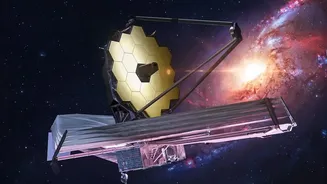
41 light-years away. It is nearly twice the diameter of our own planet. While not the first time hints of water or gases have been found, these new findings provide some of the most compelling evidence to date that rocky worlds, even those in extreme environments, can sustain substantial atmospheres. This confirmation is a pivotal moment, validating the cutting-edge capabilities of the JWST and pushing the search for habitable worlds into a new and exciting phase. It demonstrates that we now possess the technology to move beyond simply finding exoplanets to actually characterising them in detail.
How Webb Peers into Alien Skies
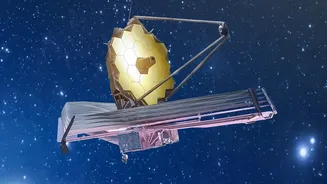
The magic behind this discovery lies in the JWST's exquisite sensitivity to infrared light. Astronomers employ a technique called transit and eclipse spectroscopy. When a planet like 55 Cancri e passes in front of its star, a tiny fraction of the starlight filters through its atmosphere. Different gas molecules absorb specific wavelengths of light, leaving a unique chemical fingerprint. Then, as the planet moves behind the star, its own heat signature vanishes. By measuring the drop in light during this 'secondary eclipse', scientists can calculate the planet's temperature. Webb's powerful instruments, MIRI (Mid-Infrared Instrument) and NIRCam (Near-Infrared Camera), can capture these minuscule variations with unprecedented precision, allowing scientists to deconstruct the atmospheric composition and climate of worlds light-years away.
Meet 55 Cancri e: A Hellish World
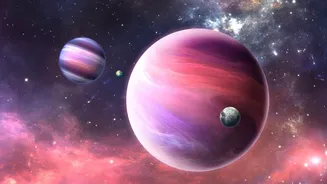
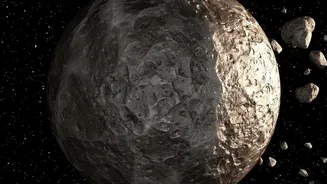
It is crucial to understand that 55 Cancri e is no Earth 2.0. This super-Earth orbits its star so closely that a year lasts a mere 18 hours. Its surface is likely a roiling ocean of molten magma, with temperatures soaring to around 2,800 degrees Fahrenheit. The planet is probably tidally locked, meaning one side perpetually faces its star in eternal daylight while the other is cloaked in endless night. Initial theories suggested such a world, blasted by intense stellar radiation, could not hold onto an atmosphere. However, the JWST data suggests otherwise. The temperature readings were cooler than expected for a bare, incandescent rock, indicating that an atmosphere is present and circulating heat from the dayside to the nightside. This atmosphere is thought to be 'secondary', meaning it is being constantly replenished by gases venting from the vast magma ocean below.
Water Vapour or Carbon Monoxide?
The data from 55 Cancri e points to an atmosphere rich in volatile gases like carbon monoxide or carbon dioxide. While the headline focuses on water vapour, which has been tentatively detected in the atmospheres of other rocky exoplanets like GJ 486 b, the key finding for 55 Cancri e is the confirmation of a substantial atmosphere itself. In other cases, scientists have struggled to determine if a water signal was coming from the planet or from cool spots on its host star. For 55 Cancri e, the evidence for a thick blanket of gas is robust. This atmosphere is likely not water-dominated but is sustained by outgassing from the planet's molten interior. This discovery provides a unique laboratory for studying the complex interactions between a planet's surface, its interior, and the atmosphere it generates, offering clues about the early conditions on planets like Earth and Venus.
The Search for Another Earth Continues
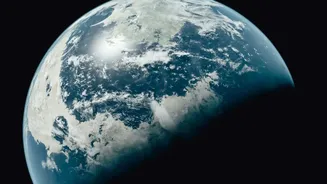
Confirming an atmosphere on a rocky super-Earth, even a hellishly hot one, is a monumental proof of concept. It proves that the JWST can perform the kind of detailed analysis needed to eventually find a truly habitable world. Each observation of planets like 55 Cancri e refines the techniques and models scientists use. The ultimate goal remains finding a rocky planet within its star's 'habitable zone'—the orbital region where temperatures are just right for liquid water to exist on the surface. With the power of the JWST, astronomers are now methodically working their way towards that goal, one exoplanet at a time. This discovery is not the end of the search, but rather the end of the beginning, opening a new chapter in our quest to understand our place in the cosmos.