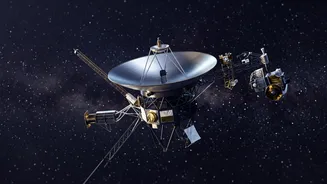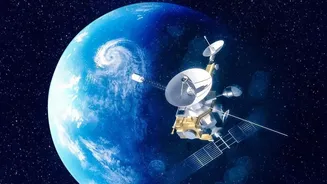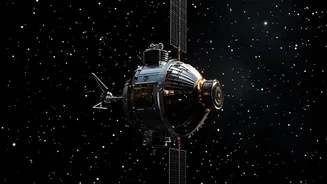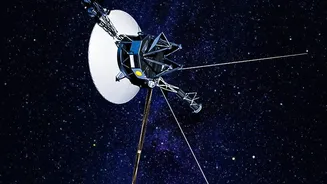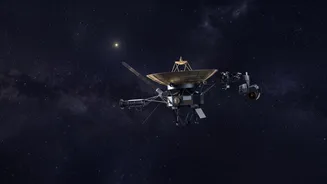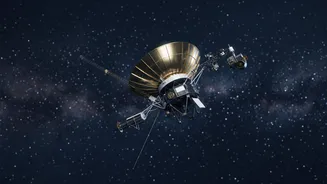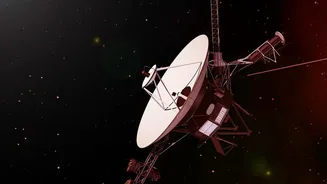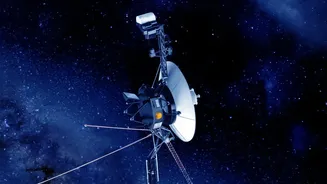


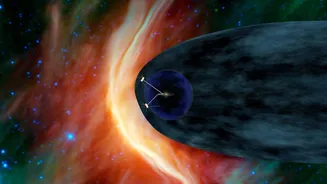
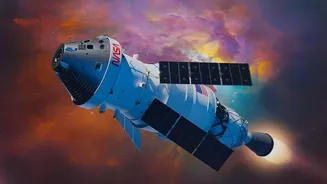
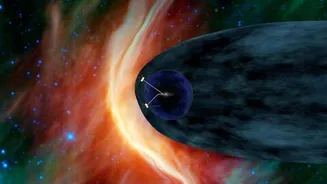
Launched in 1977, NASA’s Voyager 1 is the most distant human-made object. On November 18, 2026, it will achieve a new milestone, reaching a distance of one light-day from Earth, a testament to its nearly 50-year journey into the cosmos.
A Milestone Measured in Light
On November 18,
2026, after travelling for 49 years, Voyager 1 will be so far from home that its radio signals, moving at the speed of light, will take a full 24 hours to reach Earth. This incredible distance is known as a light-day, equivalent to about 25.9 billion kilometres. This milestone is less a physical boundary and more a profound marker of time and distance. For the engineers at NASA's Deep Space Network who command the probe, it means that sending a command and receiving confirmation will now take a minimum of 48 hours. This vast communication lag underscores the immense scale of Voyager’s journey and the challenges of operating a spacecraft in interstellar space.
A Grand Tour and a New Beginning
Voyager 1’s journey began on September 5, 1977, launched on a mission to explore the outer solar system. Its primary 'Grand Tour' saw it fly past Jupiter in 1979 and Saturn in 1980, fundamentally changing our understanding of these gas giants and their moons. The probe discovered volcanic activity on Jupiter's moon Io, revealed the complexity of Saturn’s rings, and provided the first detailed look at the thick, nitrogen-rich atmosphere of Saturn's largest moon, Titan. After its planetary encounters, the mission was extended. In August 2012, Voyager 1 made history by becoming the first spacecraft to enter interstellar space, crossing the heliopause—the boundary where the Sun's stream of charged particles gives way to the interstellar medium.
Whispers from the Void
Keeping a probe operational for nearly five decades is a monumental feat of engineering. Voyager 1 is powered by radioisotope thermoelectric generators, which convert the heat from decaying plutonium into electricity. With its power supply diminishing by about four watts per year, NASA engineers have become masters of energy conservation. The team has had to shut down instruments and execute clever power-saving manoeuvres, nicknamed the 'Big Bang', to keep its remaining science gear running. The probe has also faced recent technical glitches. In October 2026, it briefly lost contact with Earth for 48 hours before its autonomous fault protection systems switched to backup thrusters and re-established communication. These events are a stark reminder of the probe's age and the daily challenges of its long-distance operations.
A Message in a Bottle
Beyond its scientific instruments, Voyager 1 carries a symbolic message from humanity to the cosmos: the Golden Record. This gold-plated copper disc contains sounds and images selected to portray the diversity of life and culture on Earth. Assembled by a committee led by the famed astronomer Carl Sagan, its contents include greetings in 55 languages, music from various cultures and eras—from Bach to Chuck Berry—and natural sounds of wind, surf, and animals. It also holds 116 images of life on Earth and a map showing the location of our solar system. Should any intelligent extraterrestrial life ever encounter the silent probe, the record serves as a time capsule from a distant world.